

Golden Hammer
- the company history
Recently Added
or Updated...
Christchurch Chapel, Bridgwater
Recollections, Info,
Memories, Explanations
---------------------
Updated Feb 2022 - see new post-war section below
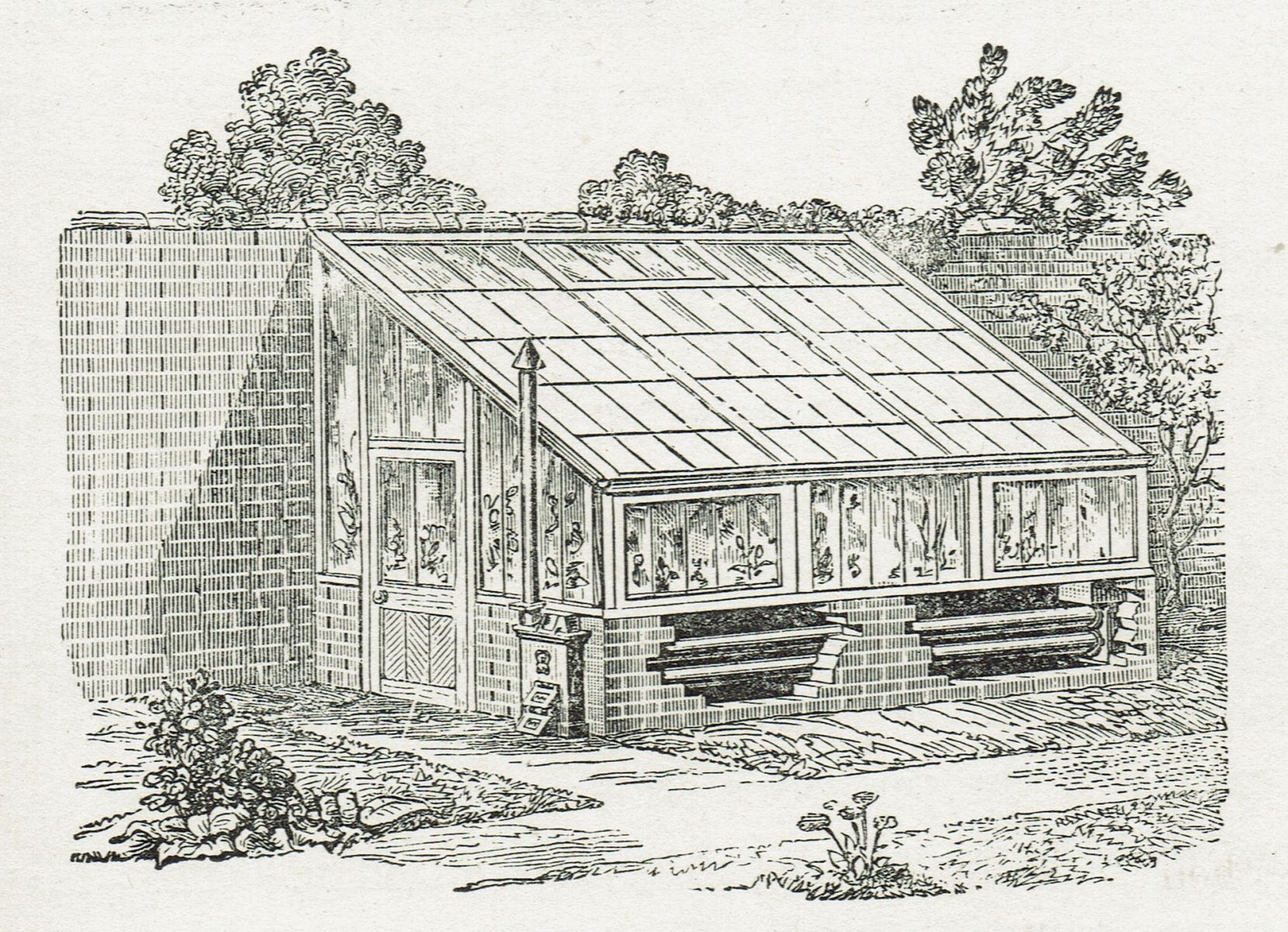
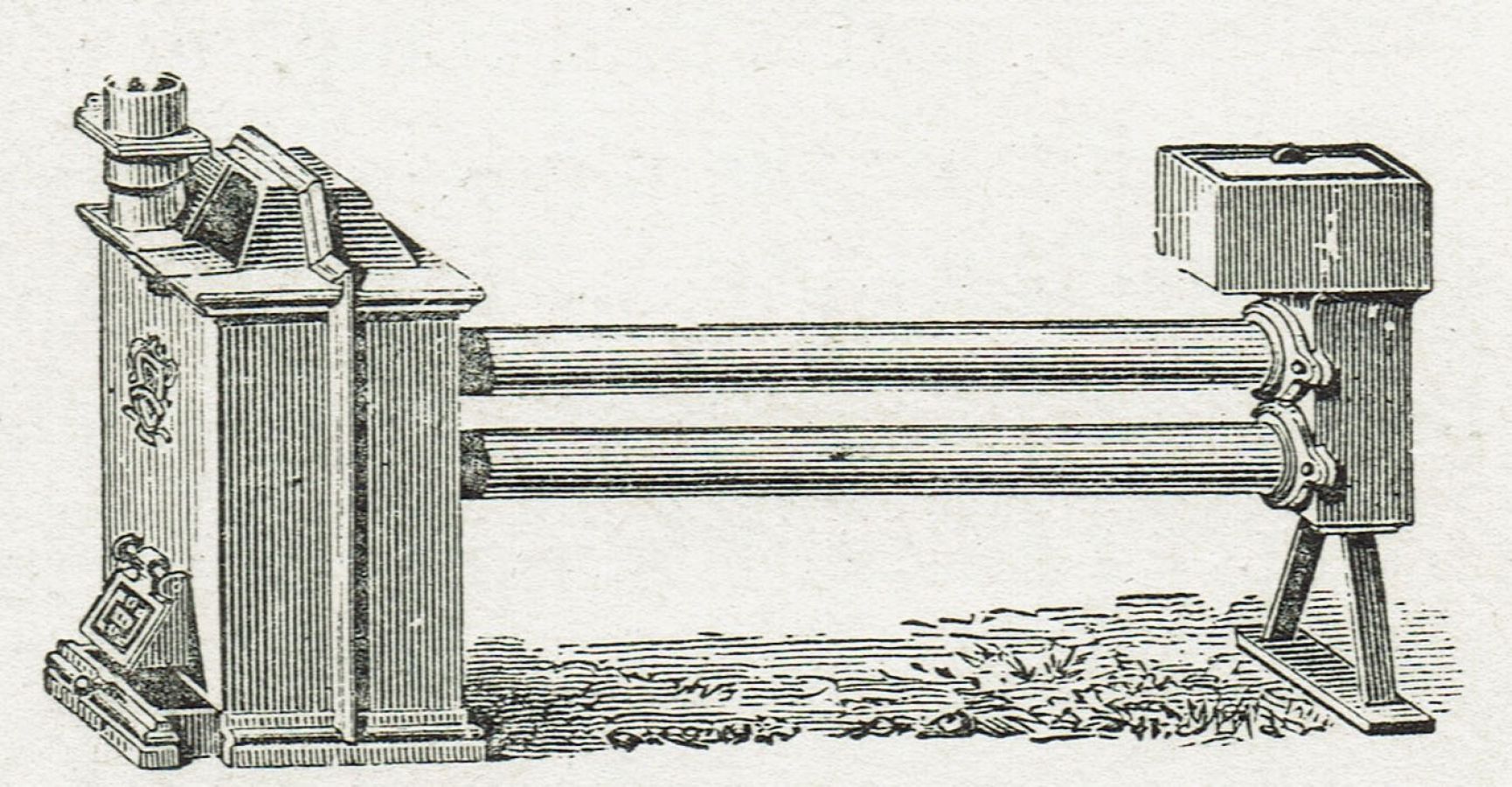
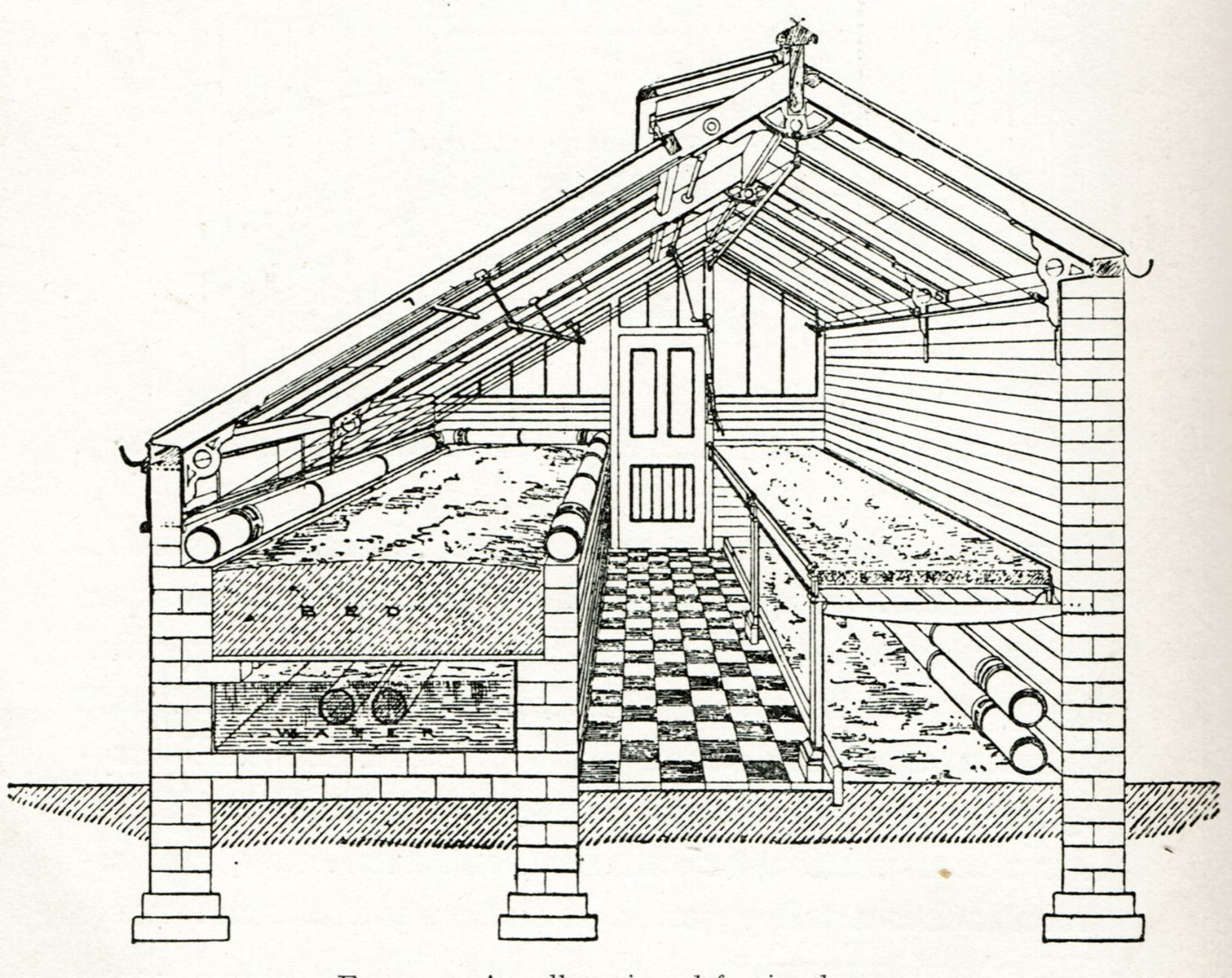
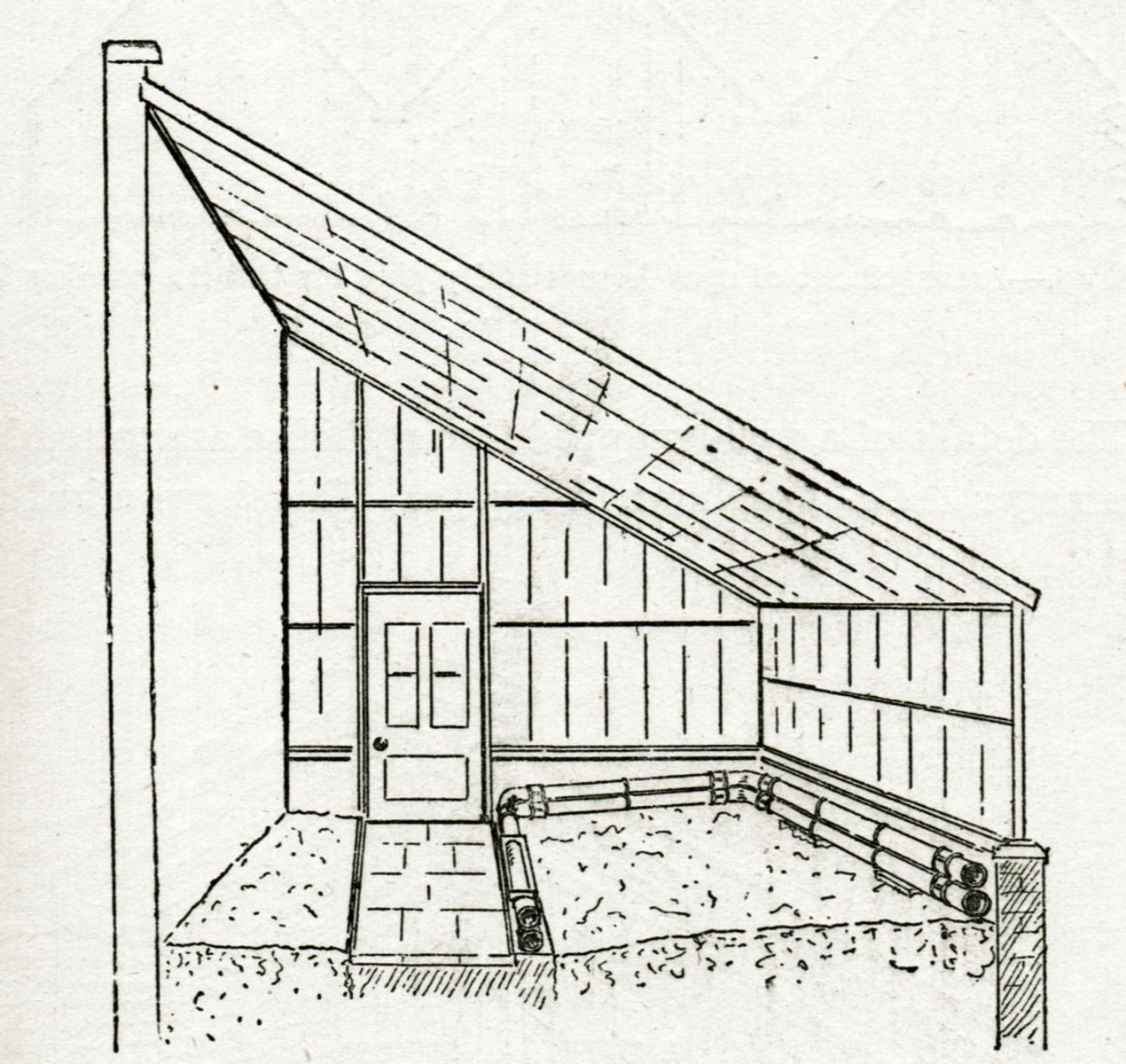
Heating was another sphere into which Garton & Jarvis and Garton & King ventured and some interesting schemes for heating melon pits and greenhouses were designed. They were involved in the heating of the Tropical House in Kew Gardens. Further research on the heating system installed at Kew is currently being undertaken.
Many churches and institutes, schools and large private houses, like Knightshayes Court near Tiverton and more recently Exeter’s Heavitree Road Police Station, have been heated by G & K who designed and installed the systems; coke and coal in the early days, then Gas and Oil-Fired. Some interesting photographs and drawings of systems and boilers are to be seen in this section and one cannot but admire some of the skill and care that has gone into some of these plans and drawings.
Garton & King were South West Agents for the Manufacturers of the Gurney Stove. Exeter Cathedral boasted Gurney Stoves (pictured below) as did many Cathedrals – some were even converted to Gas or Oil.
Sir Goldsworthy Gurney 1793 – 1875 was born in Padstow and by the age of 20 he was a practising Surgeon; however he moved to London in 1820, and although he spent over 40 years in research and experiment he never quite made his fame and fortune and is not given the recognition he deserved.
The Gurney stove improved upon the existing coke fired stoves; it had 24 cast iron fins around its cylindrical perimeter and it rested in a trough of water which evaporated with the heat thus moistening as well as transmitting heat. The fins increased the heated area and the favourable result lead to its popularity in schools, halls, countless churches and many of our large Cathedrals. He lived the latter years of his life at Poughill near Bude. Bude Heritage Centre have an excellent section on Sir Goldworthy Gurney.
In 1896 Garton & King designed and produced their own Radiator – called somewhat logically the ‘1896 Radiator’ – their name is cast into the metal. So, if you see one somewhere, perhaps in a large private house or in a National Trust property, please let me know – and don’t forget – PHOTOGRAPH IT as they are an endangered species!
St Anthony’s Chapel
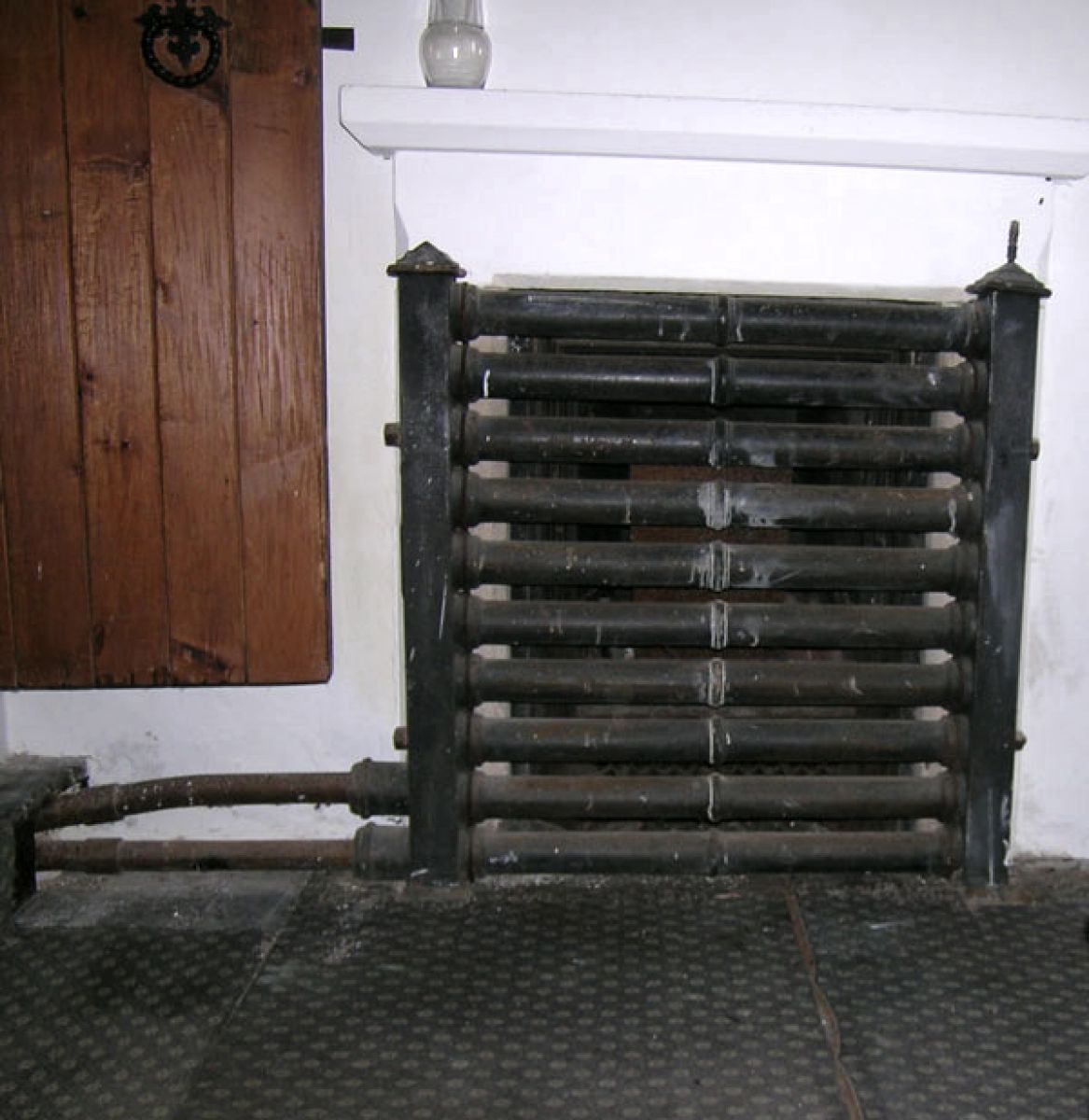
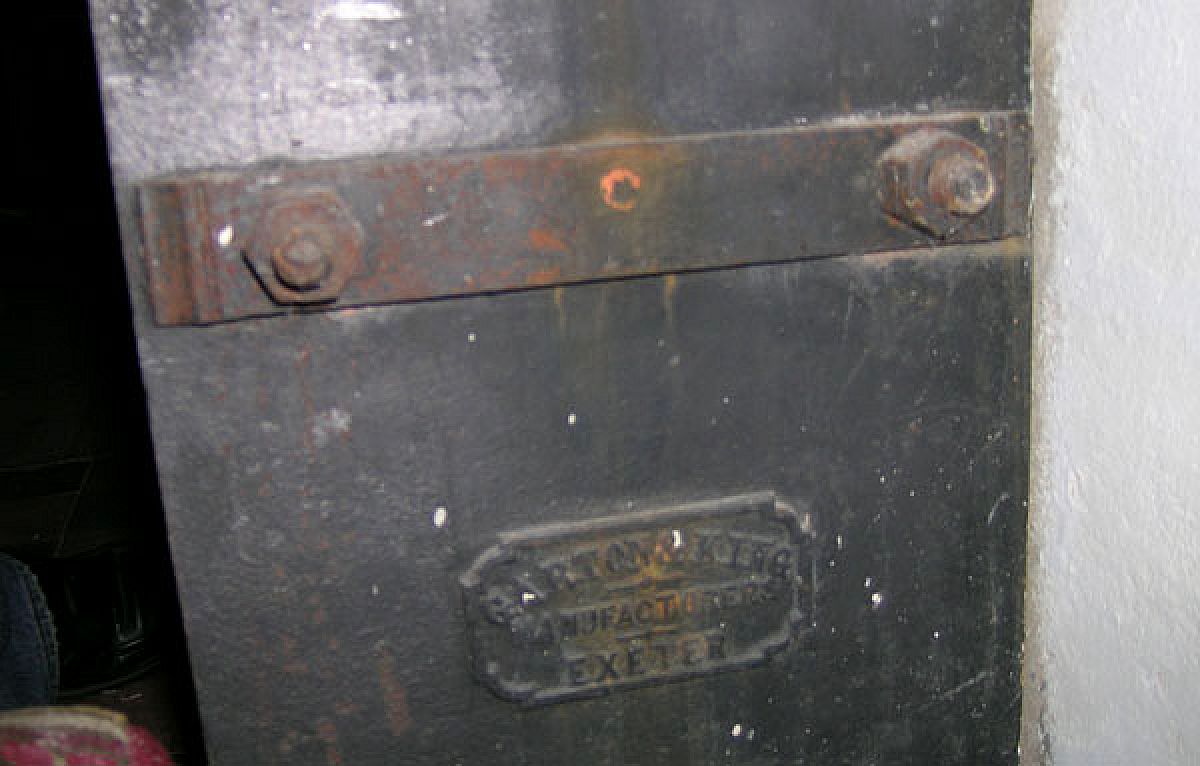 Garton & King was not all gullies gratings gears and manhole covers. These two images were taken this April in St Anthony’s Chapel at Cowley near Exeter and show that the Company were very much into various forms and systems of Heating. St Anthony’s Heating System dates from probably the middle to late 1800s and this type of radiator is particularly scarce nowadays.
St Anthony’s Chapel has now been deconsecrated and is currently up For Sale. Who knows the fate of the building and its historic Heating System.

 Christ Church Chapel, Bridgwater
Another interesting discovery of a G & K system of about the same era has been found at Christ Church Unitarian Chapel, Bridgwater - see the full description originally produced by the Heritage Group of the Chartered Institiute of Building Services Engineers for their website.
Drawing of a Steam or Hot Water Radiator
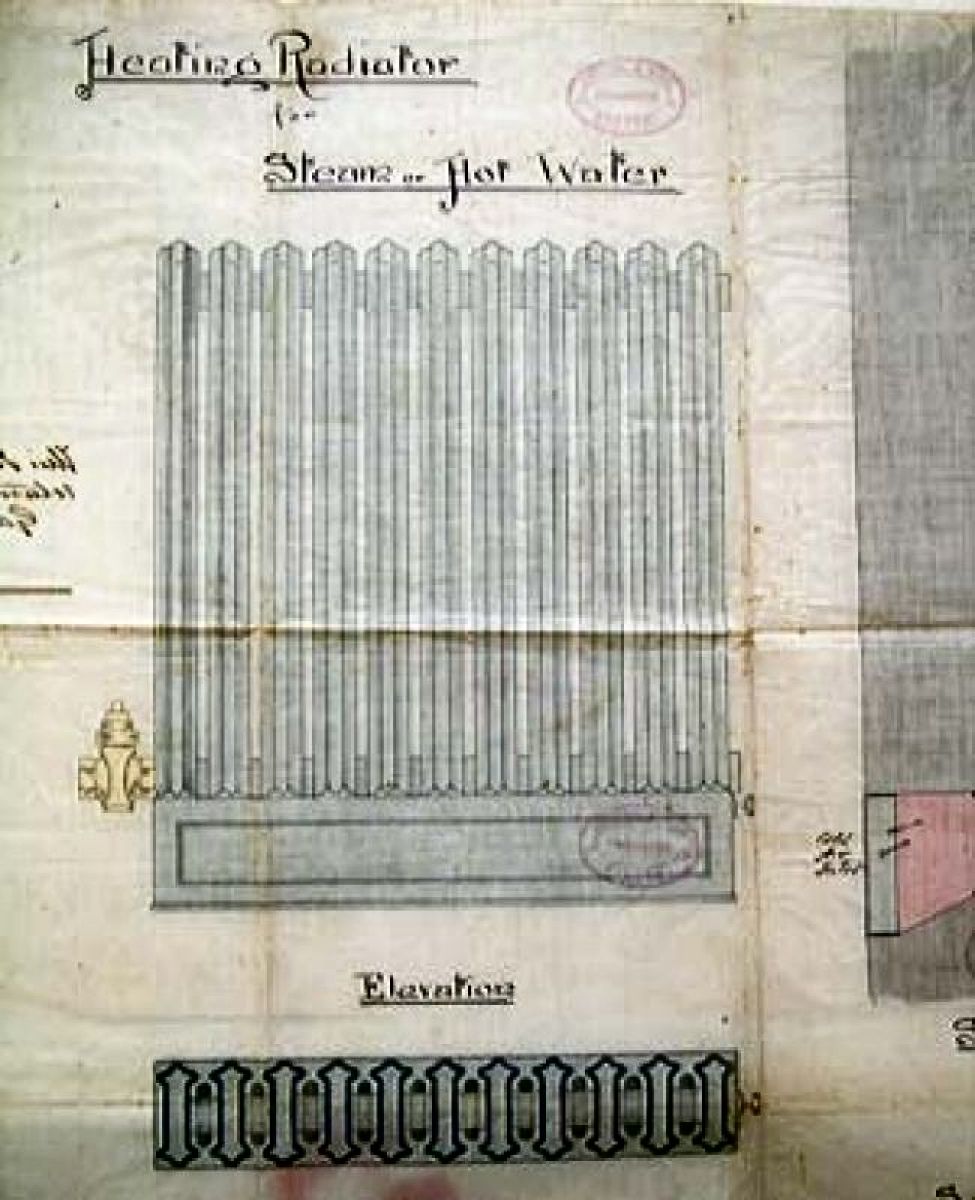 Particularly attractive drawing but unfortunately lacking much information. The Rubber Stamp (see section on Rubber Stamps) only confirns that it is pre 1924. There were many Radiator Companies around in the late 1800s, one in particular was the American Radiator Company. Their Trade Mark was a four leafed Clover with the word ‘Ideal’ written across it. Their September 1904 catalogue lists over 30 different types including hinged and and curved types. By 1919 they appear to have changed their name to The National Radiator Company.
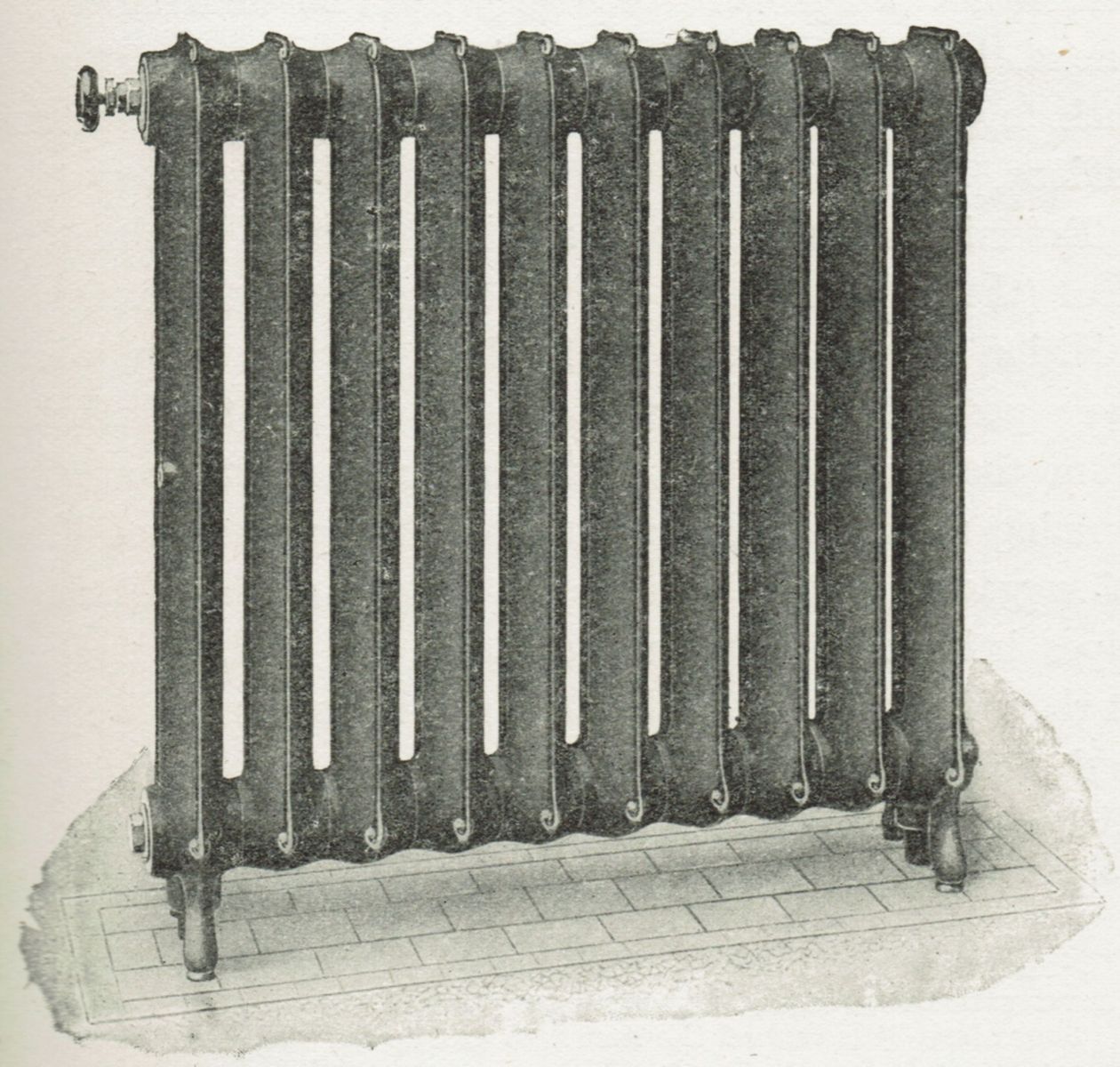 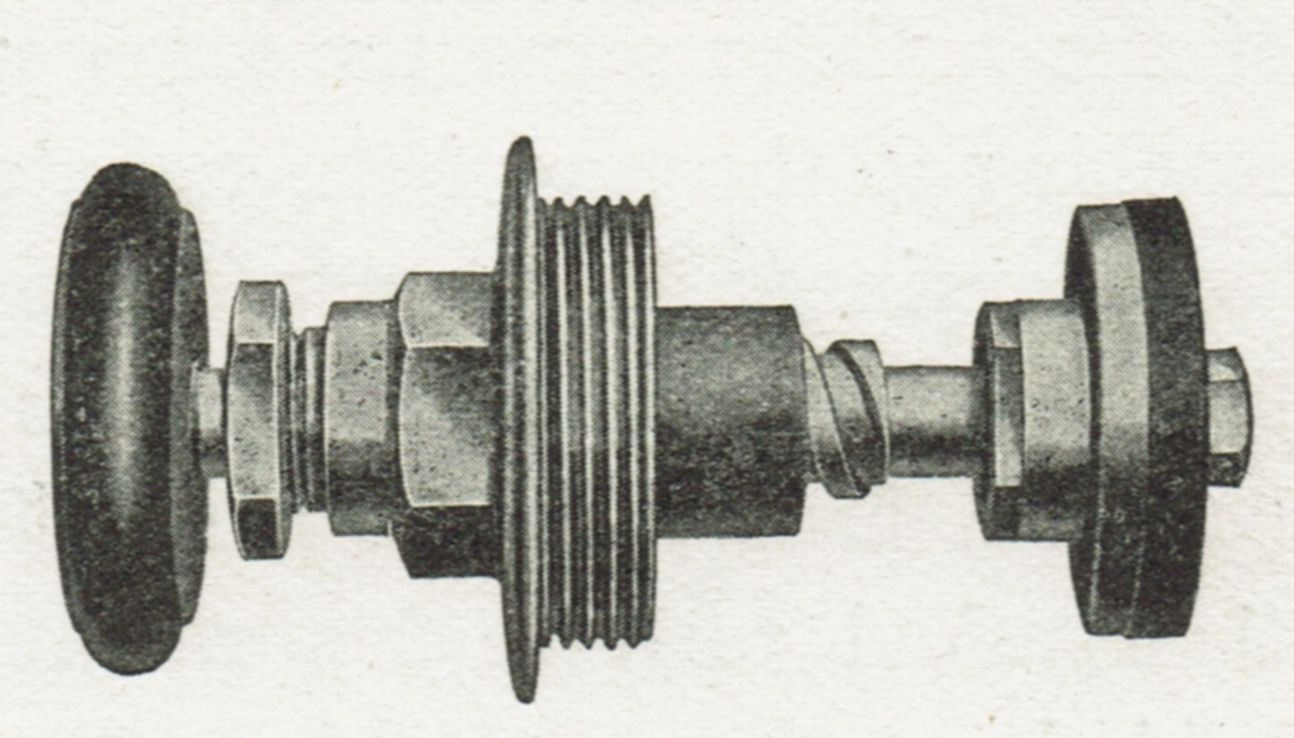 1920s 'underfed' radiator and its valve (not G & K) |
The Exon Radiator
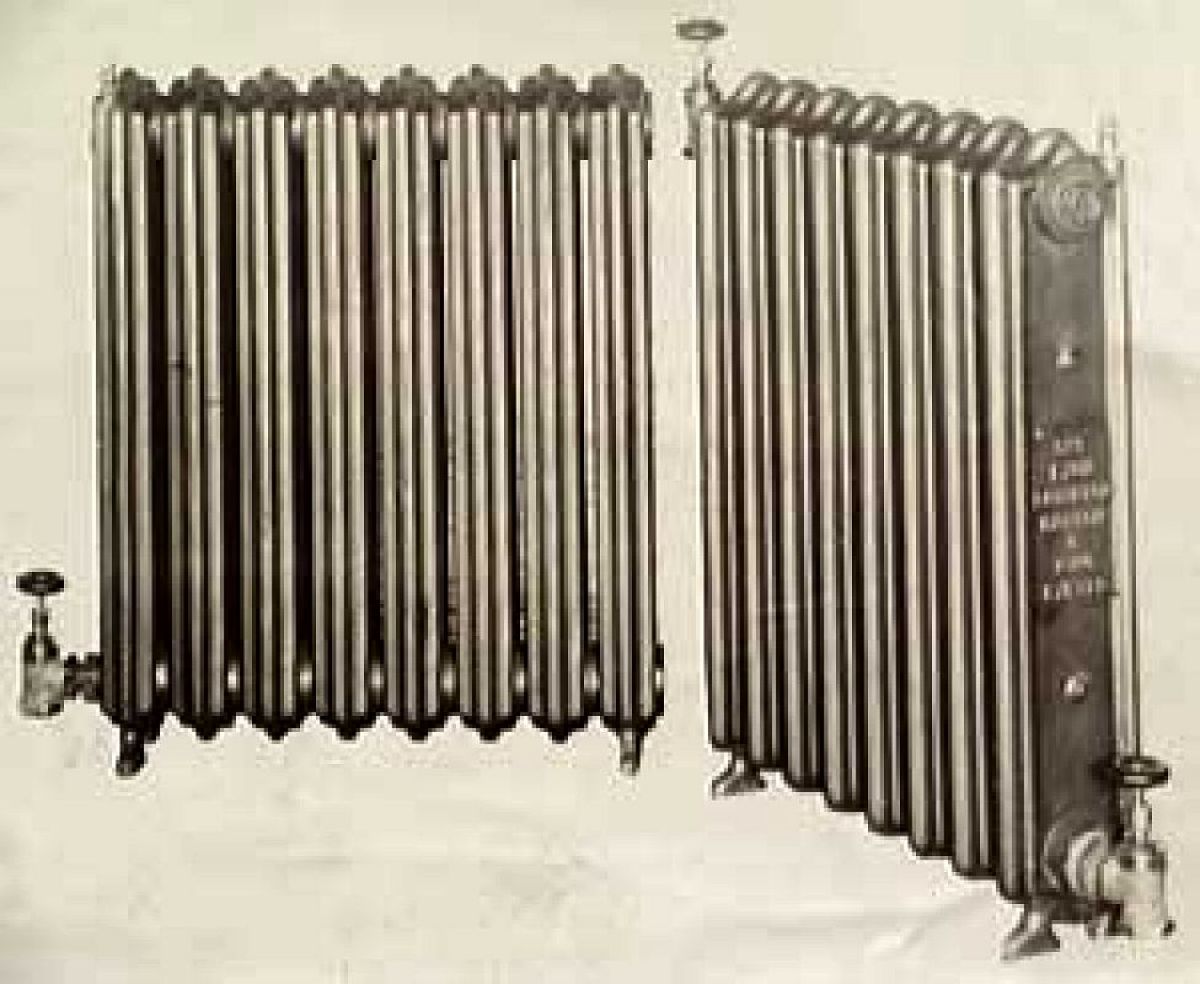 The Exon Radiator appears to be a replacement for the 1896 Radiator. Perhaps the powers that be realised that calling the Radiator the 1896 meant that by 1897 it was out of date! The publicity attached stated: “This radiator, constructed of any number of separate loops, is perfectly connected without bolts and every one is severely tested under Hydraulic and Steam Pressure before leaving our Works”
The Humble Fireplace
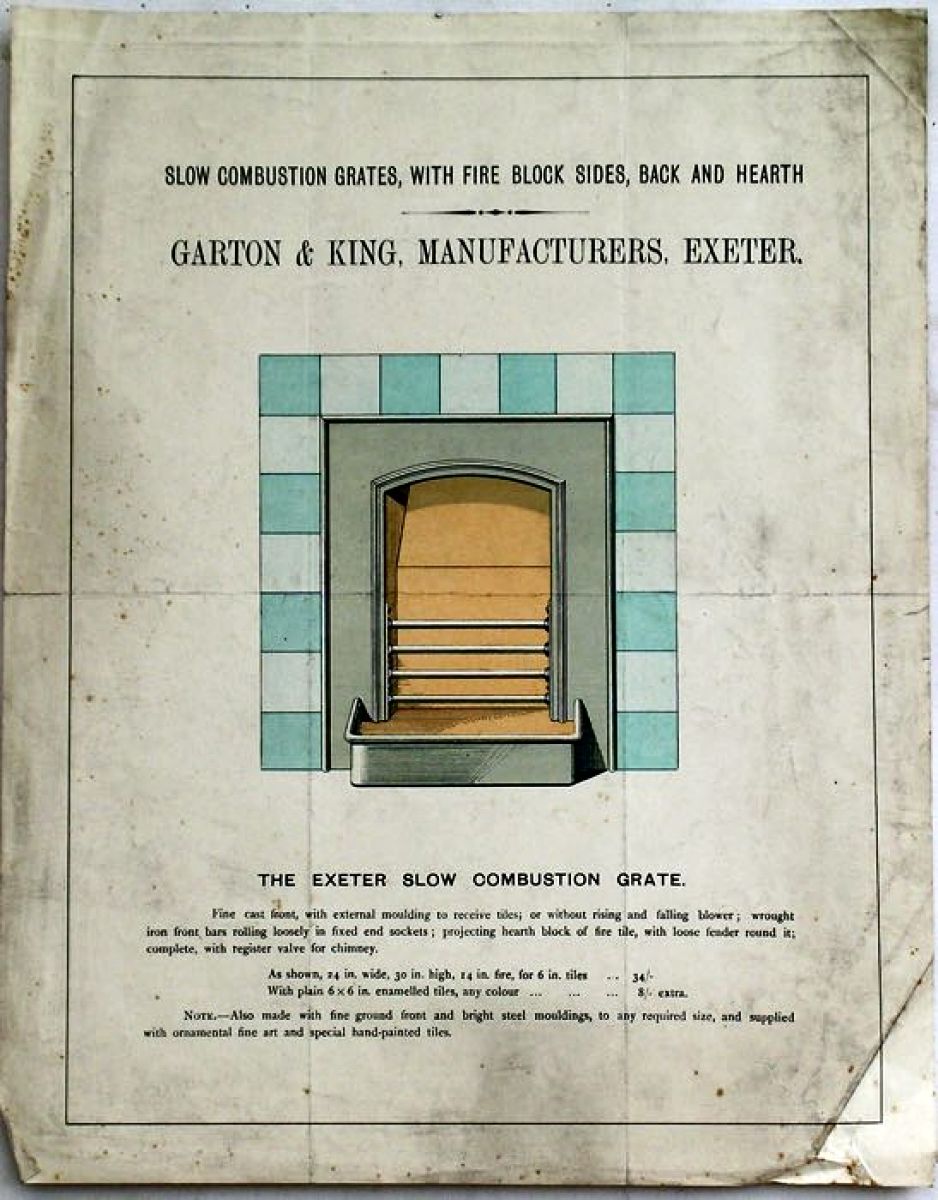 The most basic means of heating for a room in Victorian times would have been a small coal fire in a cast iron fireplace. Up until recently searches at local Architectural Salvage yards have provided no examples of cast iron fireplaces made by the company, indeed I had come to the conclusion that I would never find an example of a Fireplace bearing the Company name.
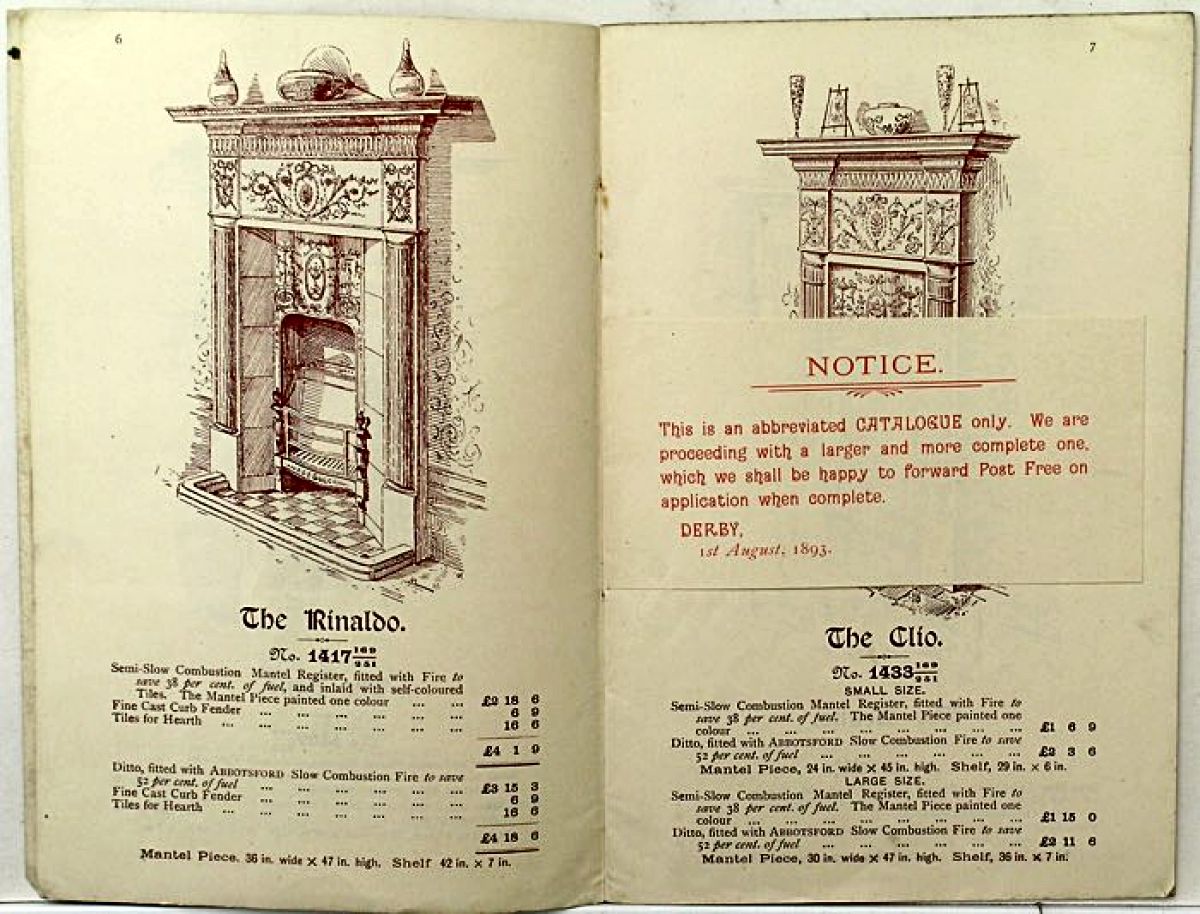 As with most Ironmongers in the eighteen and early nineteen hundreds these items were mass produced, and Garton & King acted as agents for the manufacturers, The Derwent Iron Foundry, Derby being an example of one and a page from their catalogue of 1893 is shown, Carron was another.
However, just as I had become resigned to the fact that I would never find a fireplace bearing the Company name, along comes an example.
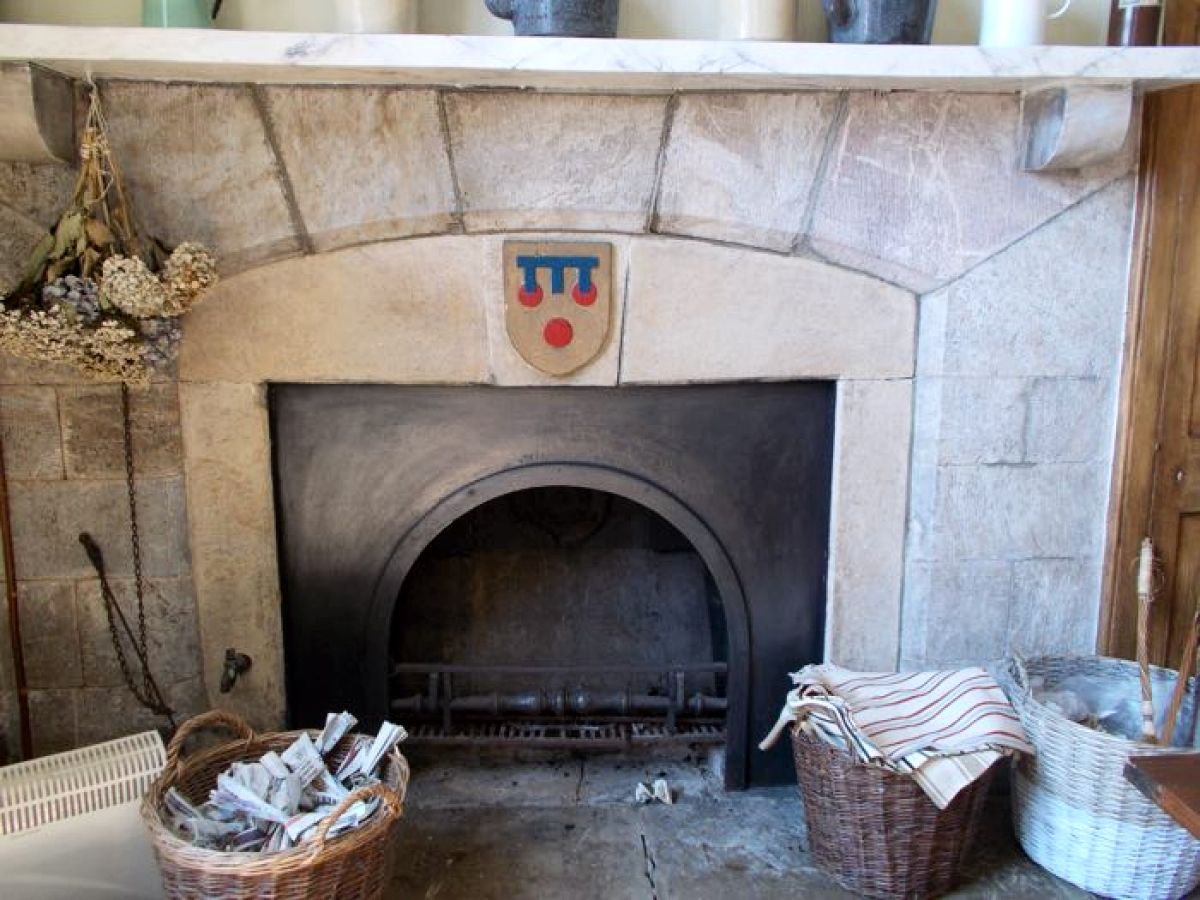
 Powderham Castle in Kenton, is the seat of the Courtenay Family, Earls of Devon. The Exeter Local History Society Tour offered in July 2018 a Tour of the Castle and I tagged along. The company had many dealings with the Courtenay family over the years, from repairing a Coffee Pot to supplying Cooking Ranges and many other goods and services between those extremes.
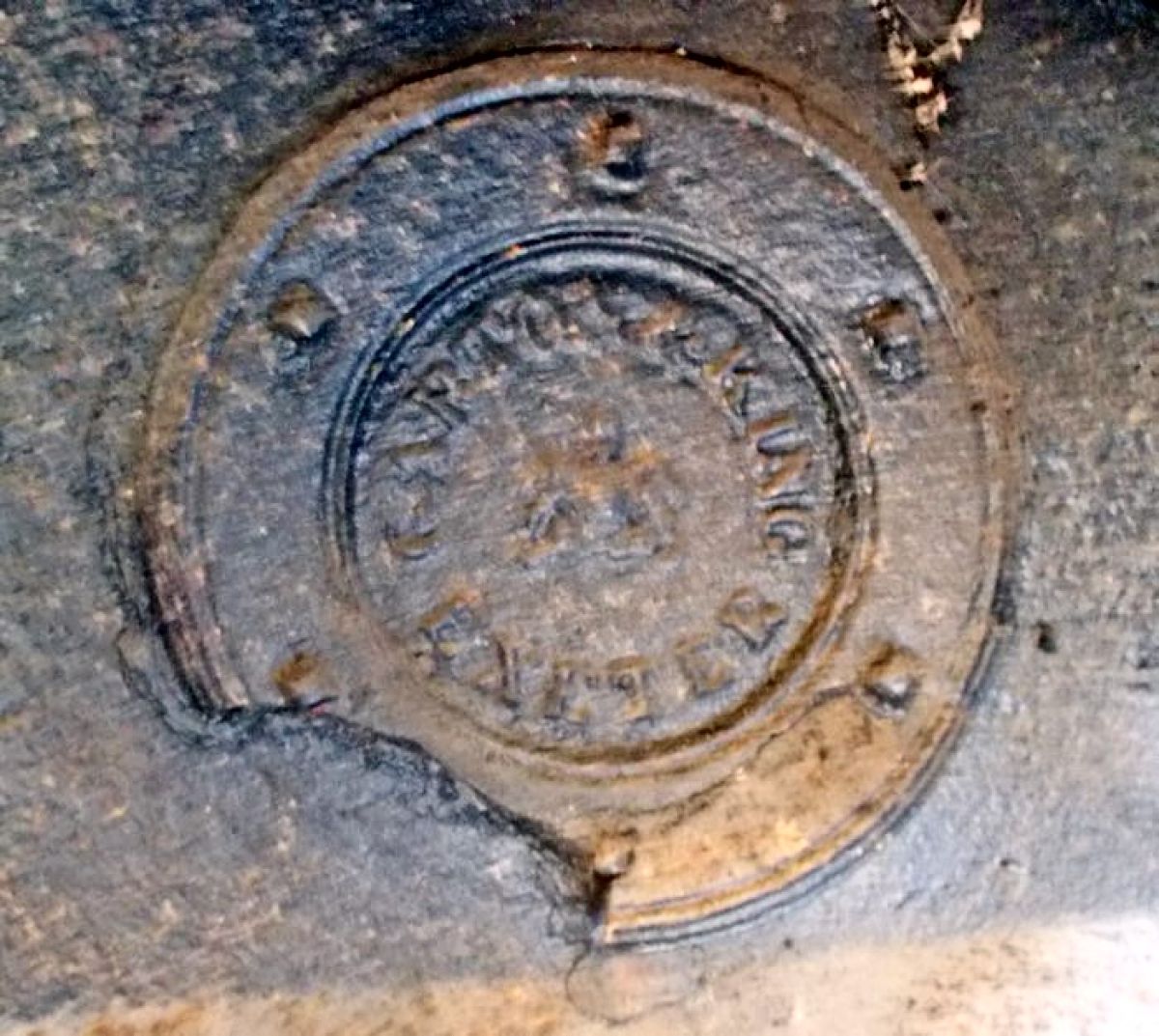
After numerous rooms and nothing noted the last port of call was the kitchen and scullery area. There was indeed a large Victorian range but not ‘one of ours’ as it flaunted the name ‘Wright and Sons’, I moved to the last room before the stairs up to the Gift Shop. In the far corner was a fireplace but I took no notice of it and was on my way up the stairs but my partner called me back and pointed it out to me. Having knelt down I realised that on the backplate cast into the ironwork in a circular shape and barely decipherable were the words ‘Garton & King, Exeter’.
I sought permission to photograph the Fireplace and I have included the images
The School Grate
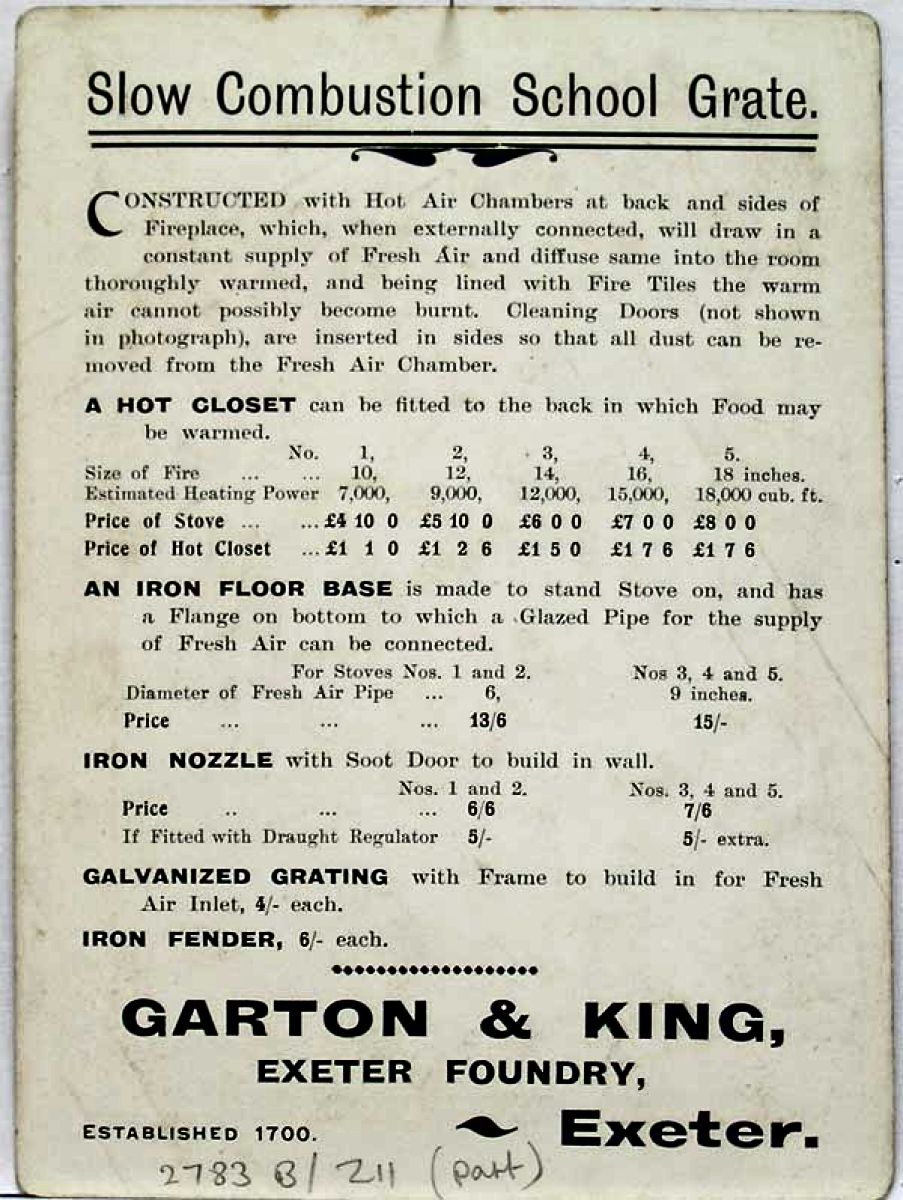
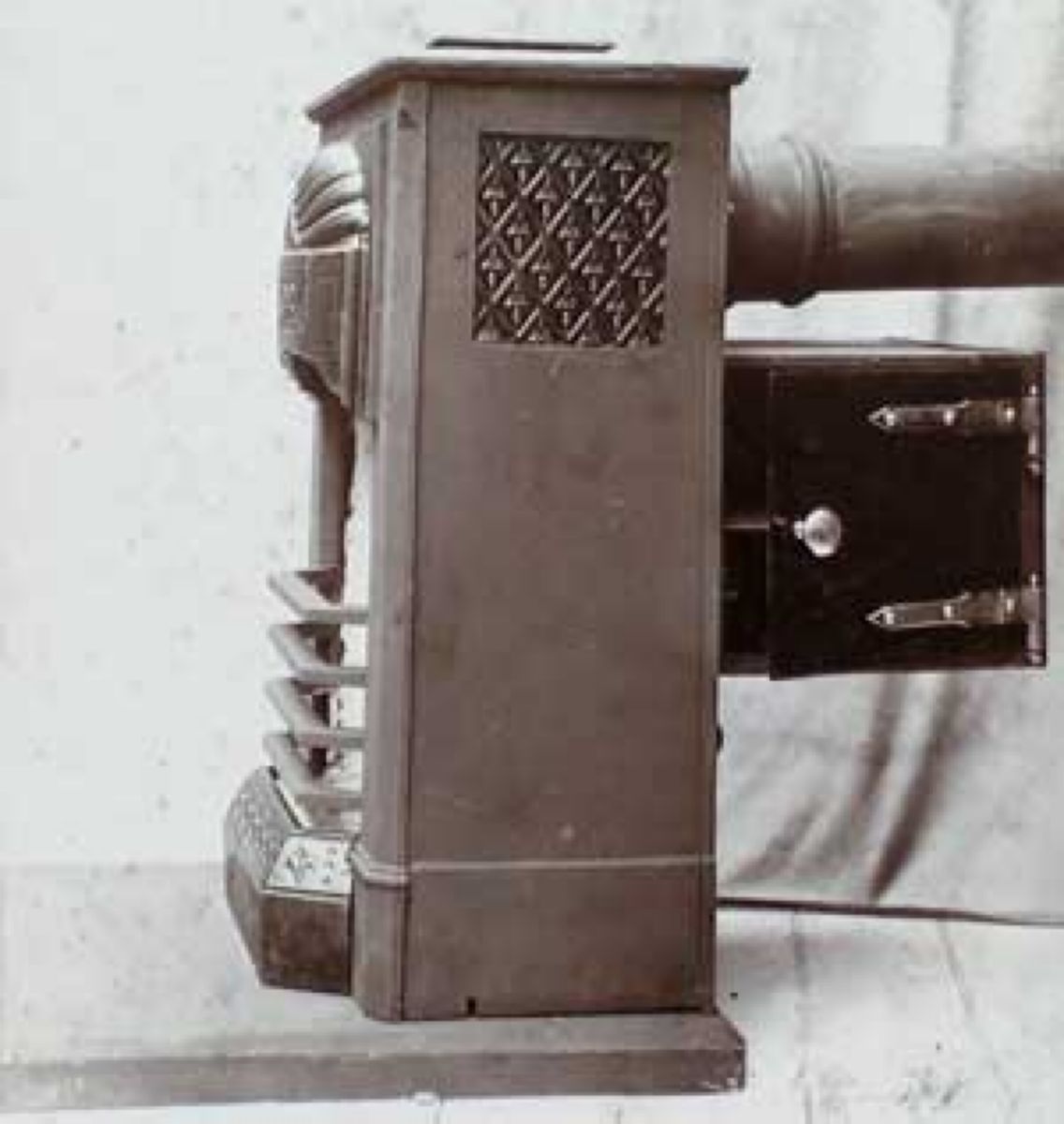 A Slow Combustion Stove. The Sales Description gives the full Low Down on this design and stresses the combustion is very slow and the consumption most economical – the appliance projects into the room and warms a given space by the distribution of warm air in addition to the heat radiated from the fire – perhaps little Jimmy’s hands will get warmer, the ink de–frost and his writing, as a result, will improve considerably through the use of this frugal appliance.
John Garton Junior’s 1848 Price Book
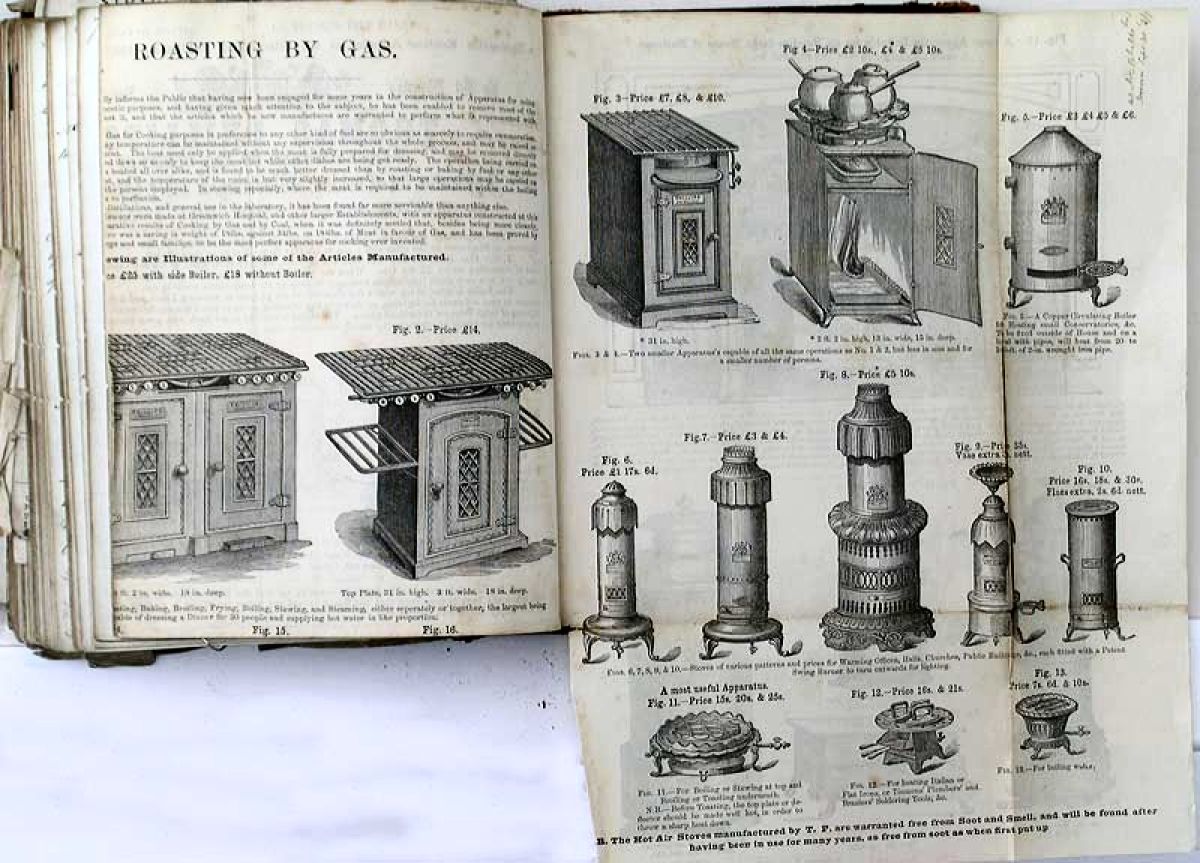 His book was absolutely crammed with facts figures, illustrations, notes and manufacturers leaflets. Here (right) we see examples of various designs of Gas Stoves by T. Philips of ornate design.
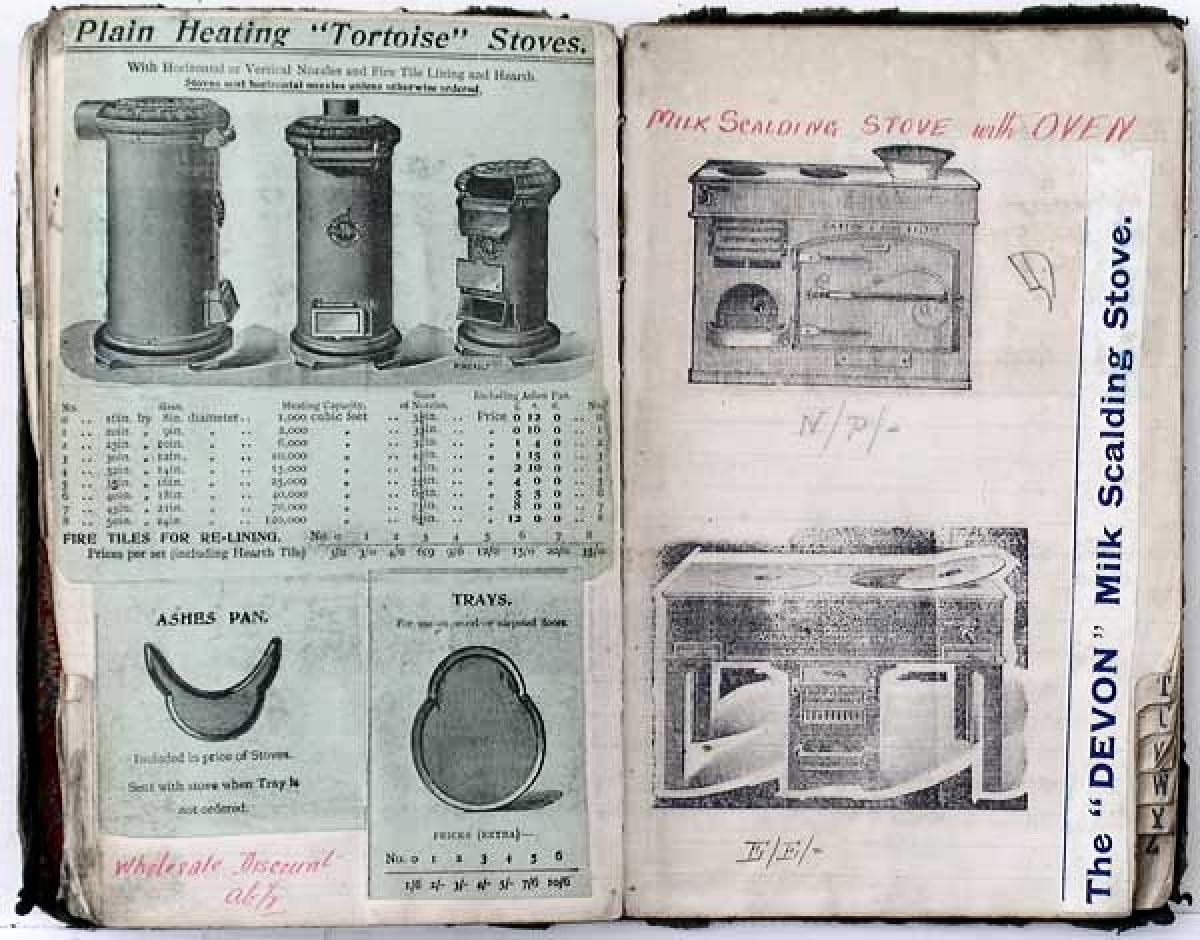 Tortoise stoves & prices. Again from the 1848 notebook of J. Garton Jnr.
The Gurney Stove
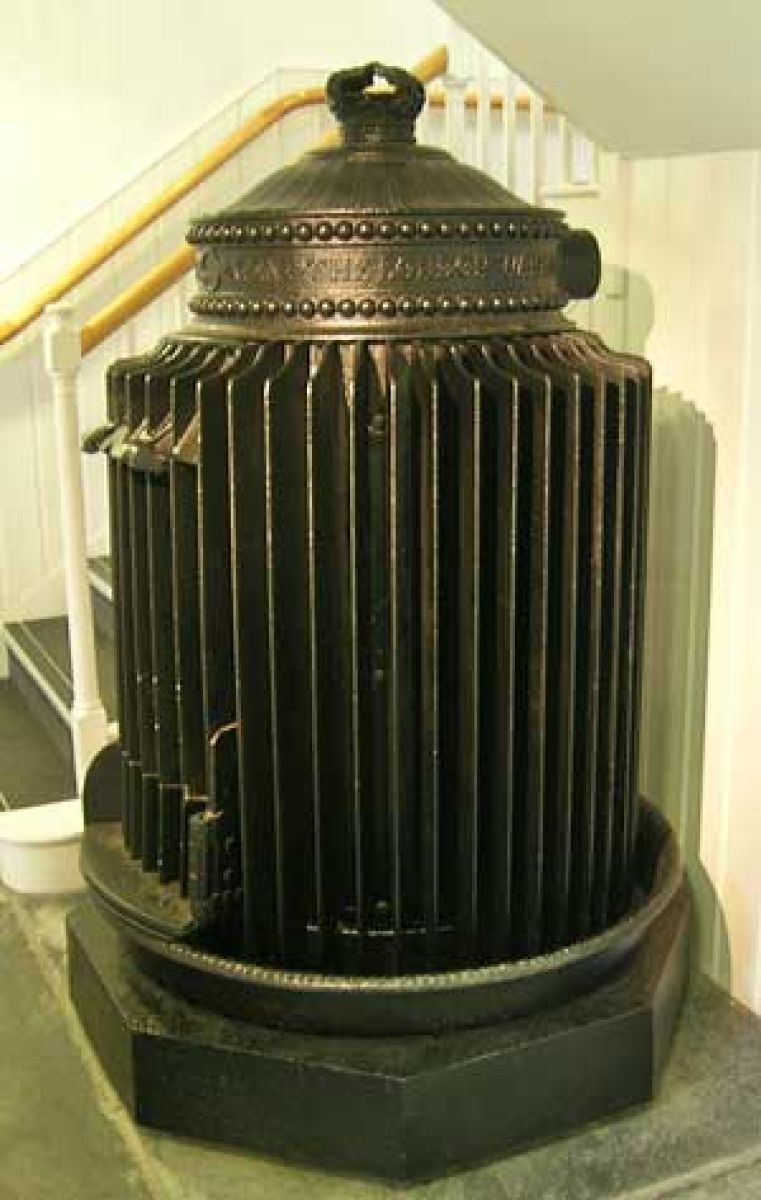
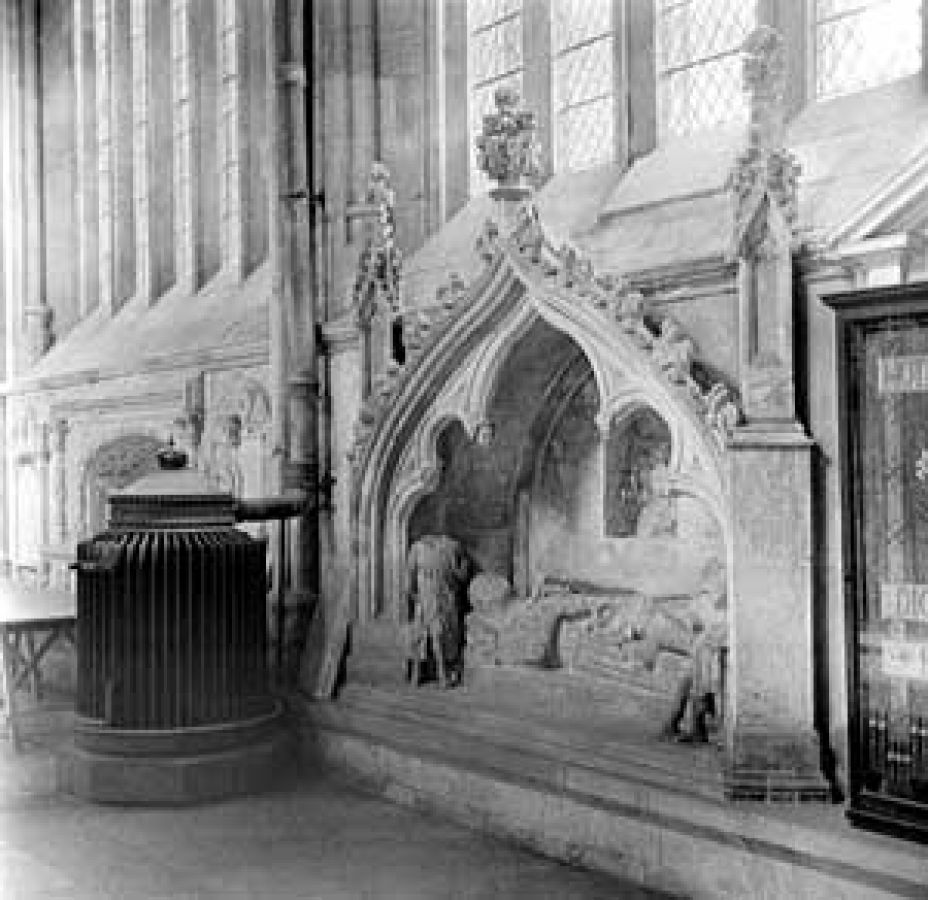 (left) This is one of Exeter Cathedral’s Gurney Stoves taken some while back – Garton & King converted one or more of these stoves to either oil or gas fired. (see the Exeter Cathedral page)
(far right) A close up of the Gurney Stove at The Castle Heritage Centre, Bude. (My thanks to them for allowing me to photograph it).
The Wash House, King Street, Exeter
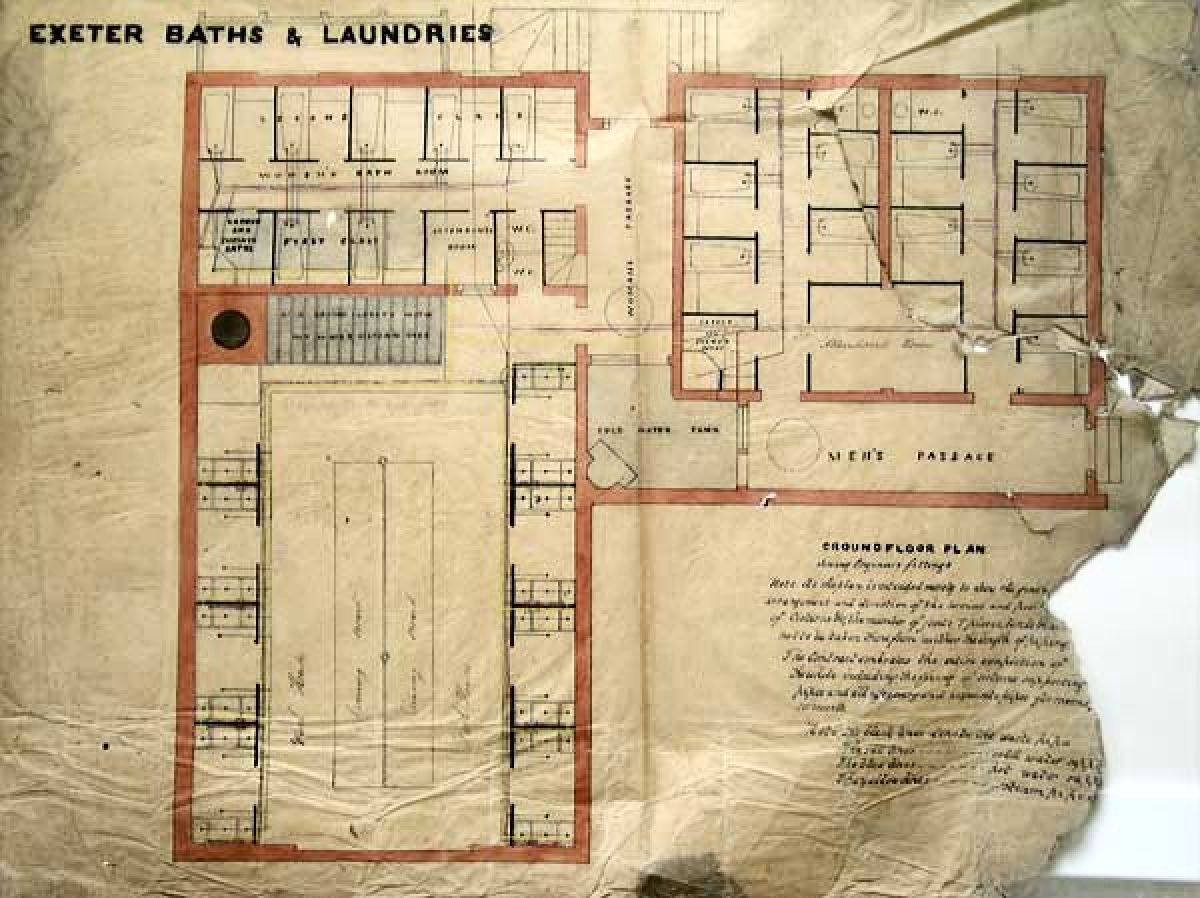 The diagram shows that the Womens Bath area is divided into First Class and Second Class. Oddly the colours for the pipework were Blue for the Hot, Red for the Cold Water System and Yellow for the Steam. The Exeter Bath & Laundries was opened in 1852.
Exeter Guildhall
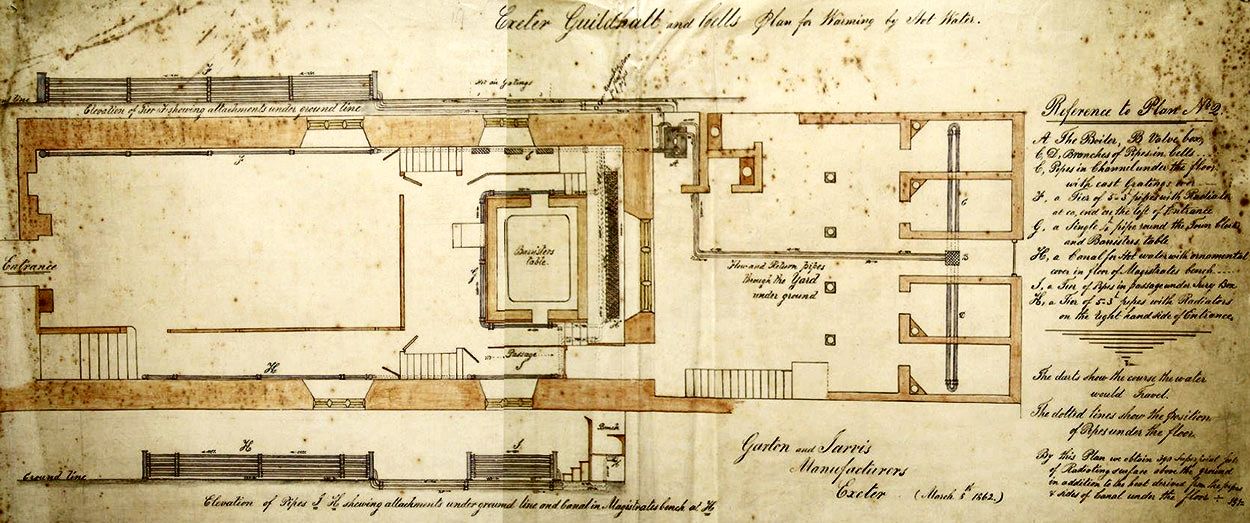 This undated but very detailed plan of Exeter Guildhall’s heating system unfortunately shows almost nothing that can be seen today although the modern Gas fuelled boiler is located in the Boiler Room shown on the plan.
Advert for Oil Stoves
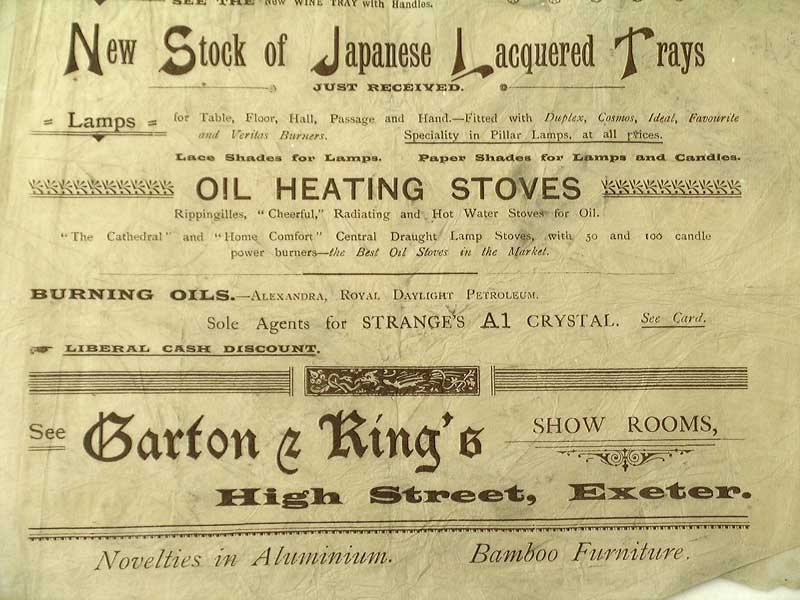 Styles of Advertising have changed a great deal since this Flyer was produced – Imaginative use of fonts and artwork. The names of the different models of Oil Stoves are somewhat amusing.
A Drawing of a Boiler
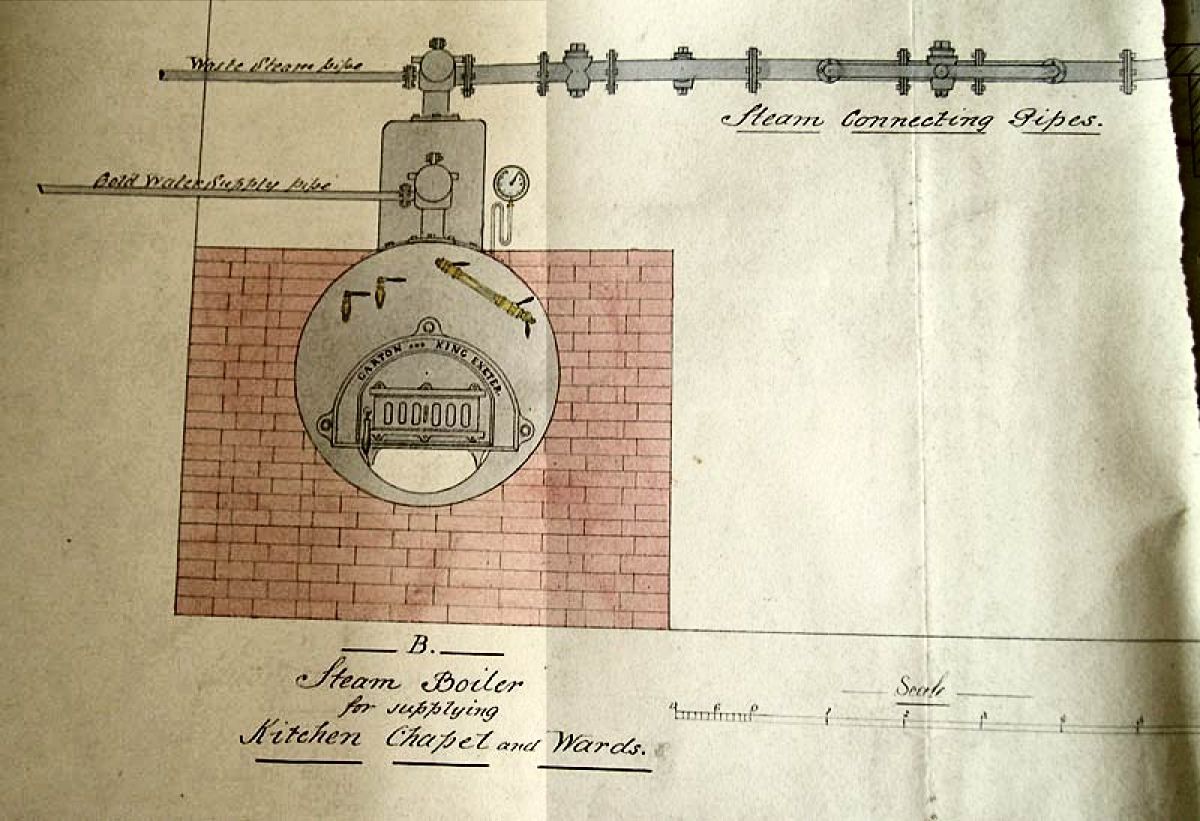 A written description does not show the care and attention given to a product by the company’s draughtsmen.
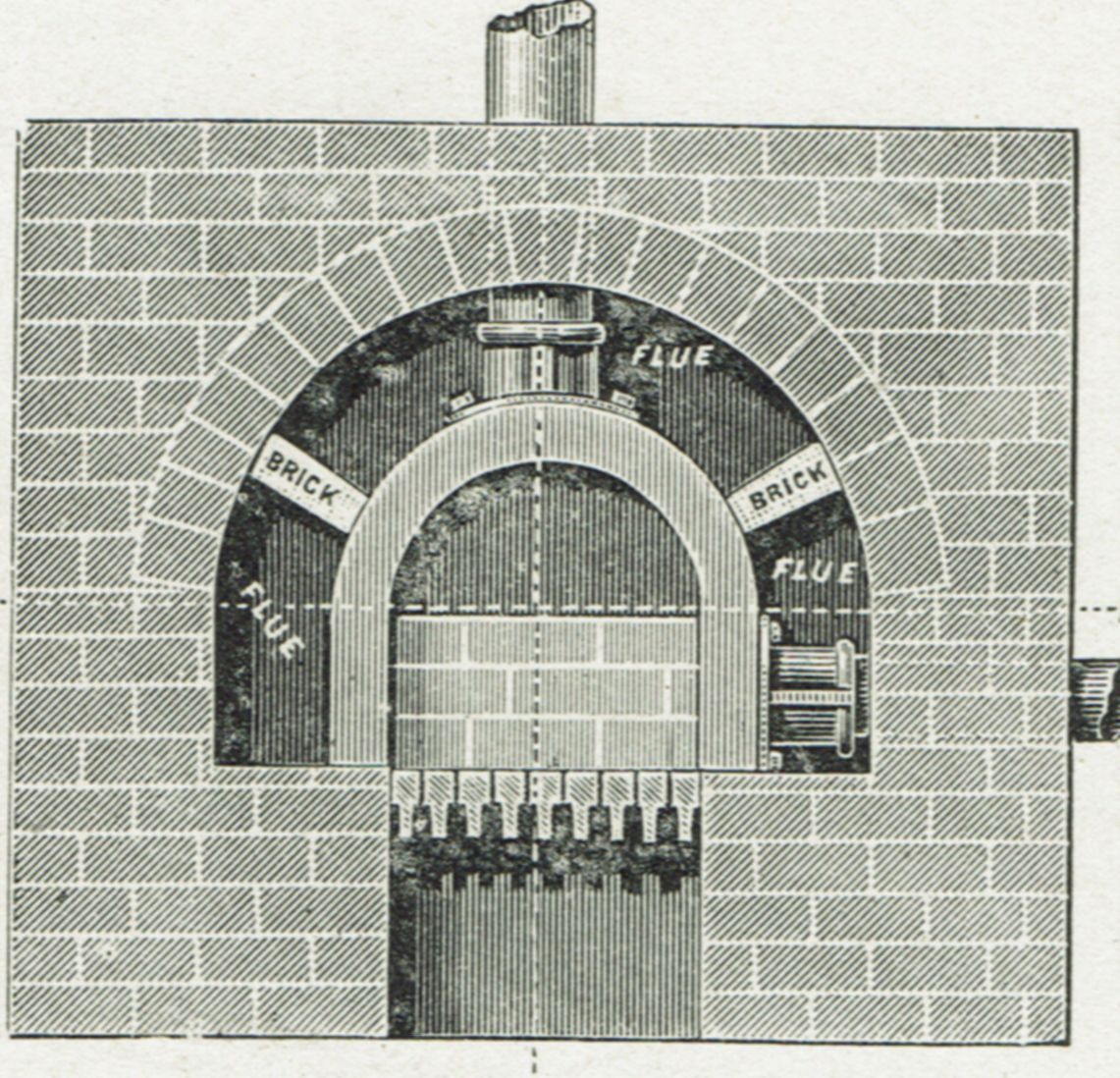 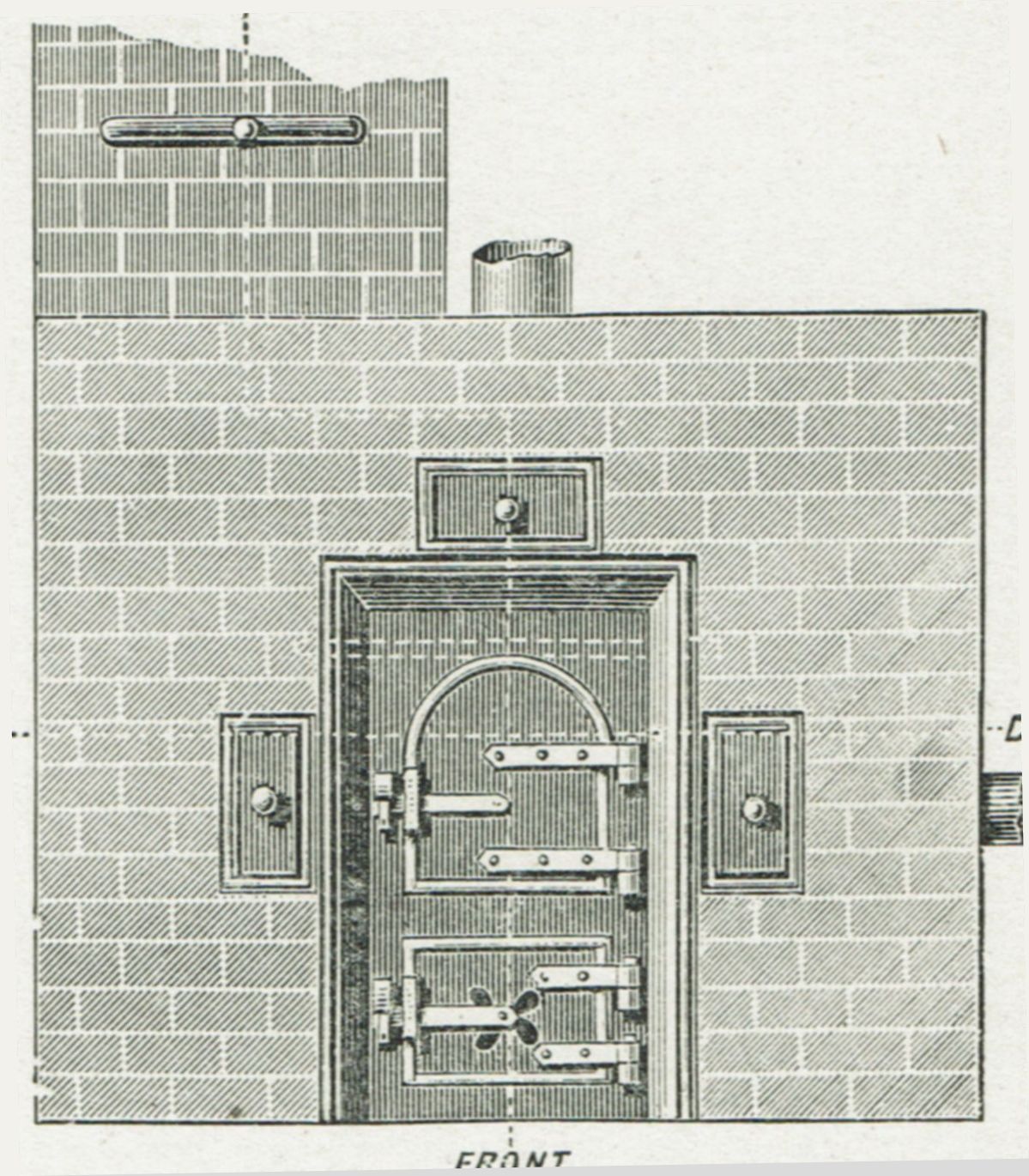 Two drawings of a Saddle Boiler |
The Boiler Room
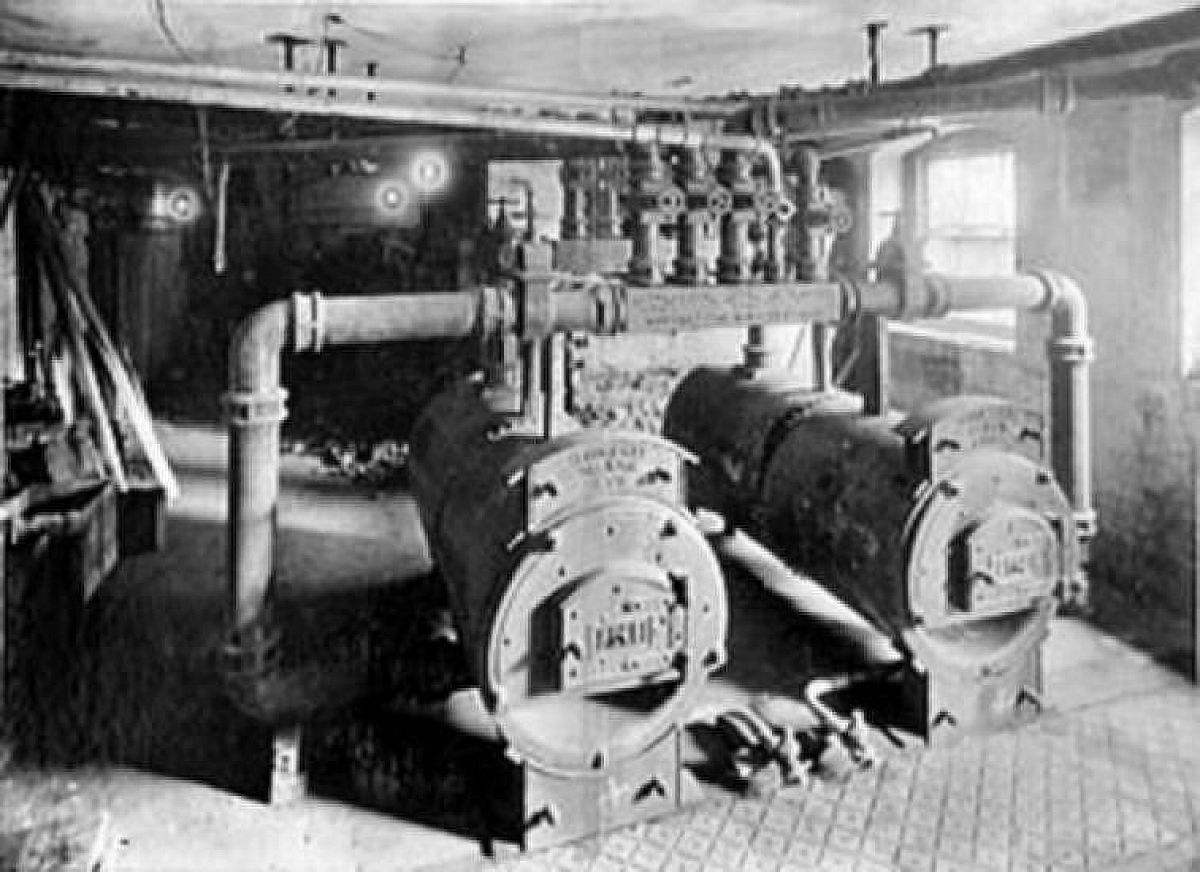 A Garton & King Archive Picture of a pair of large boilers that were installed in the Boiler House at the old Royal Devon & Exeter Hospital in Southernhay. The Inscriptions on the pipework above them and below the Valve Wheels read ‘Return Distribution Box' and 'Halford, Bowring, Halford, Cold Feed and Chapel’.
See the Devon & Exeter Hospital page for more...
Heating Pipework
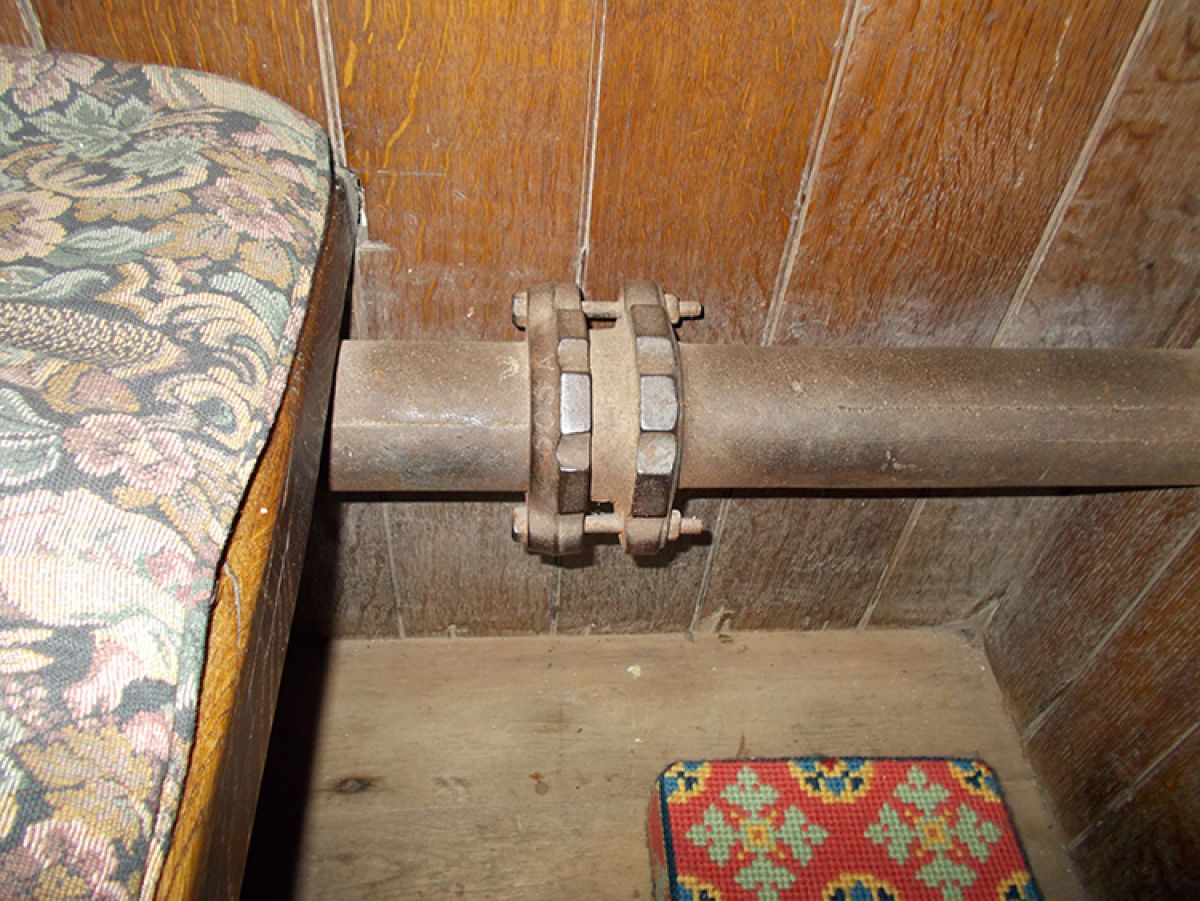 Over the decades a variety of approaches have been made to convey hot water around the premises to be heated. The first image is a view of pipework showing one method used to join pipe lengths that the company installed in Bickleigh Church in the Exe Valley
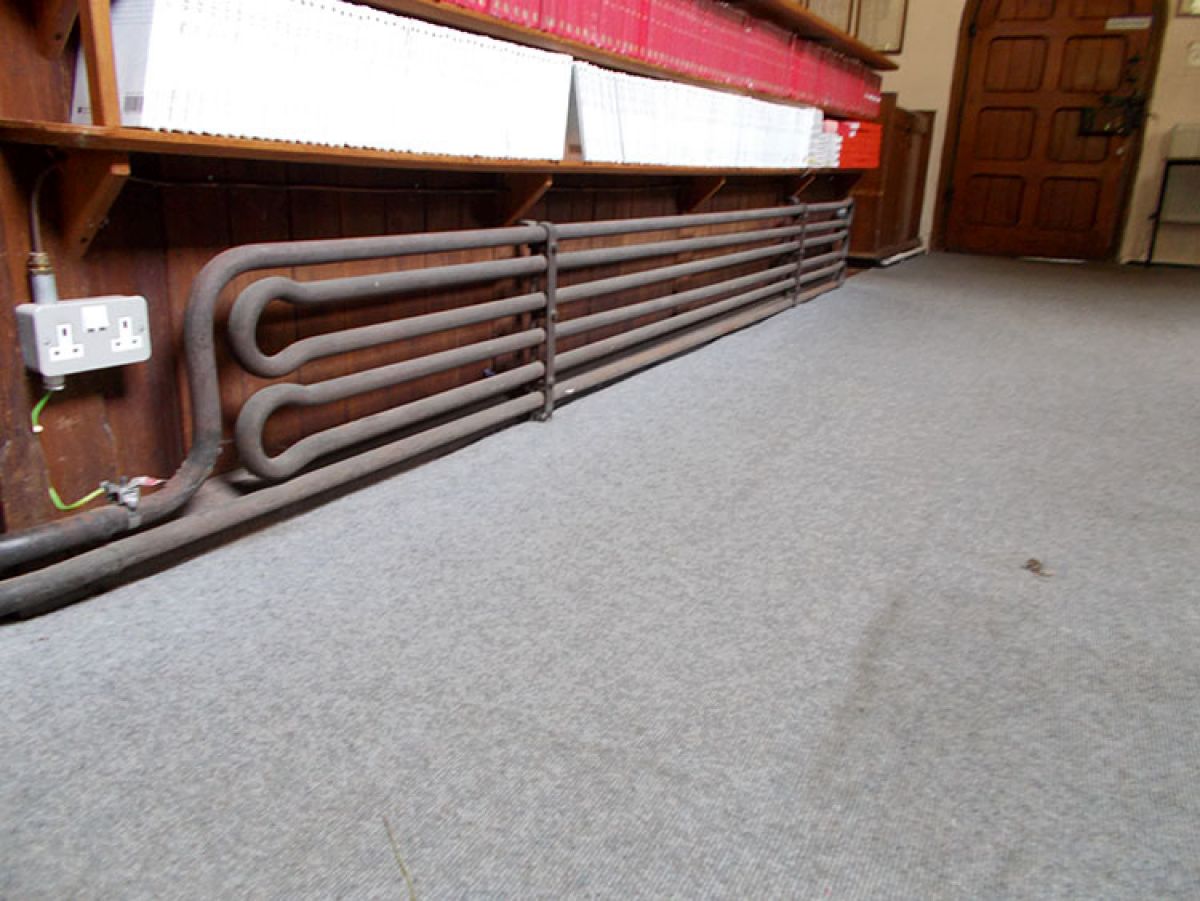
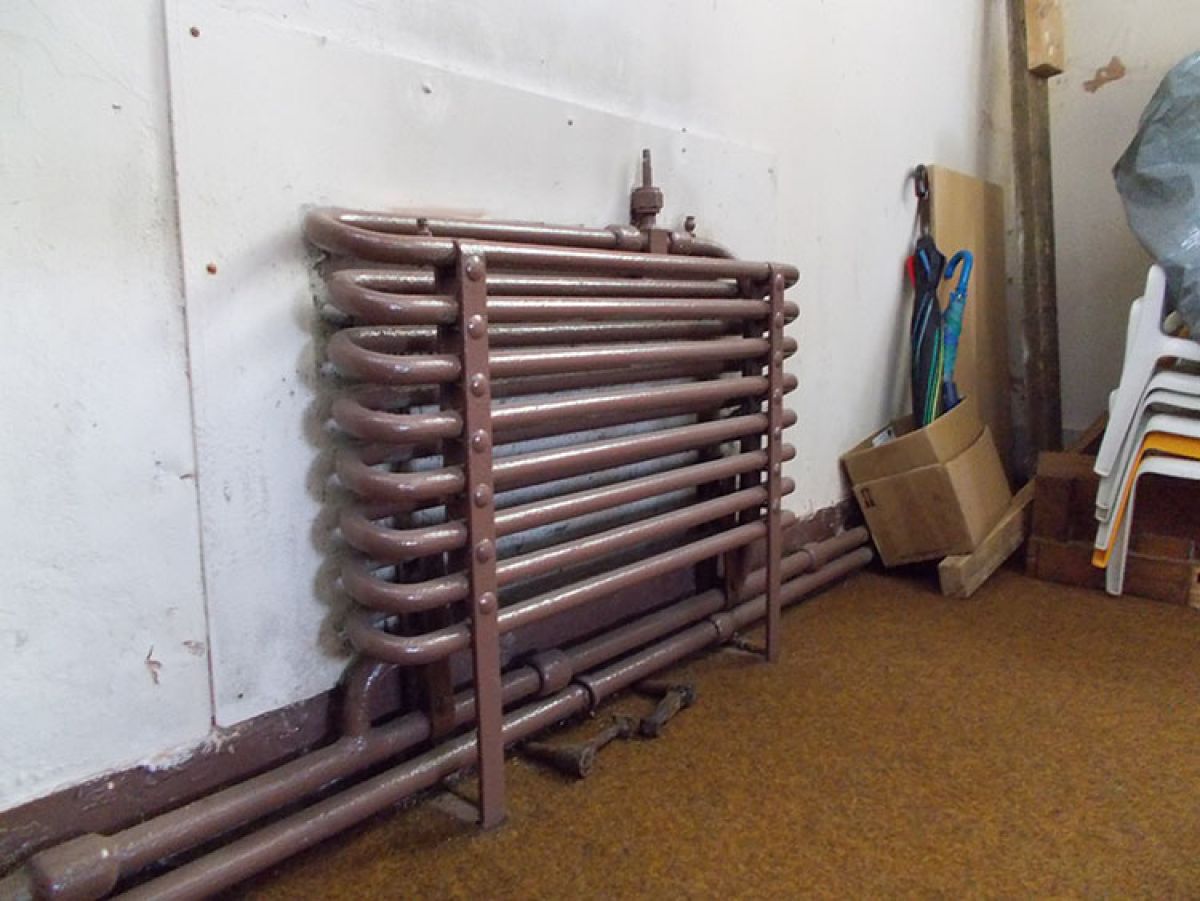 Early designs of radiators leads us to this odd example in Cornwood Parish Church (left). The next example (right) is an extended but slimmer version from St Johns in Ivybridge.
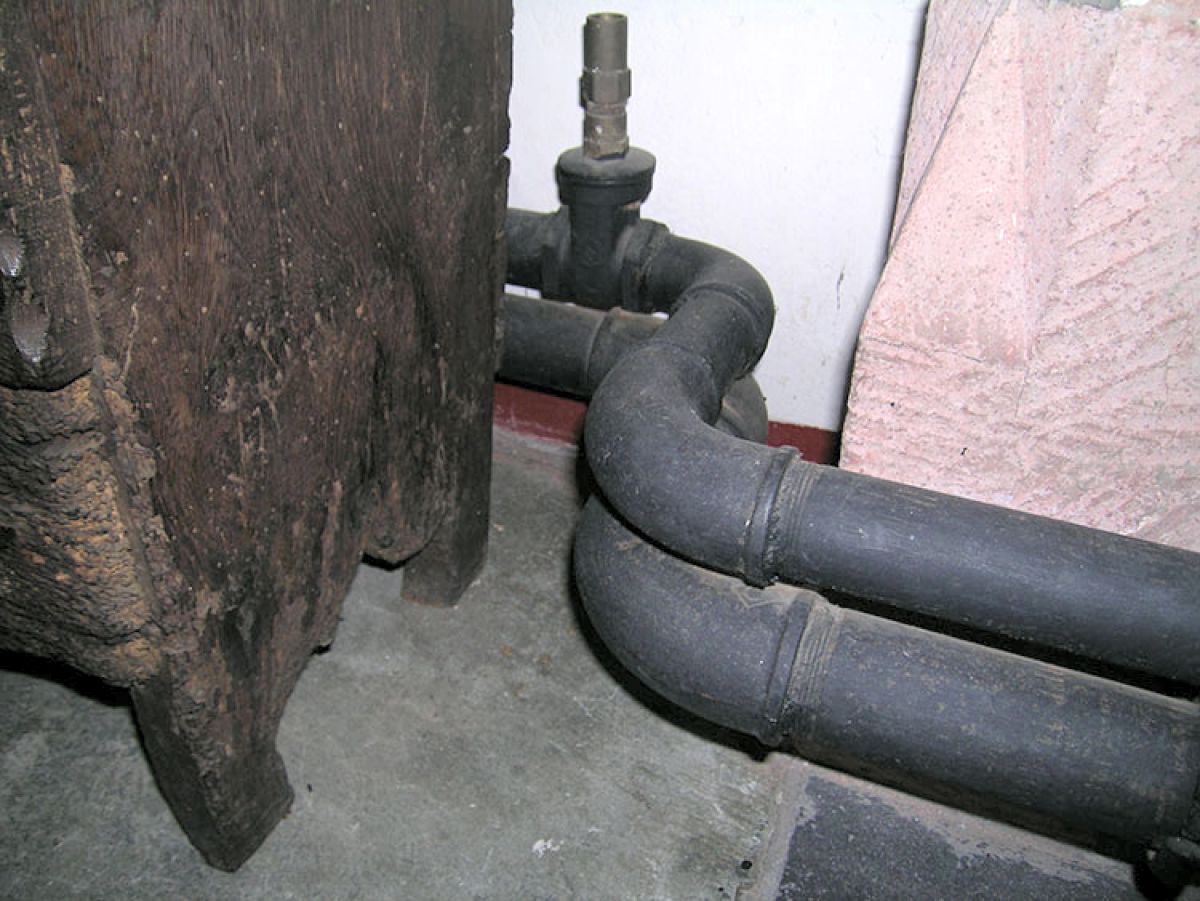
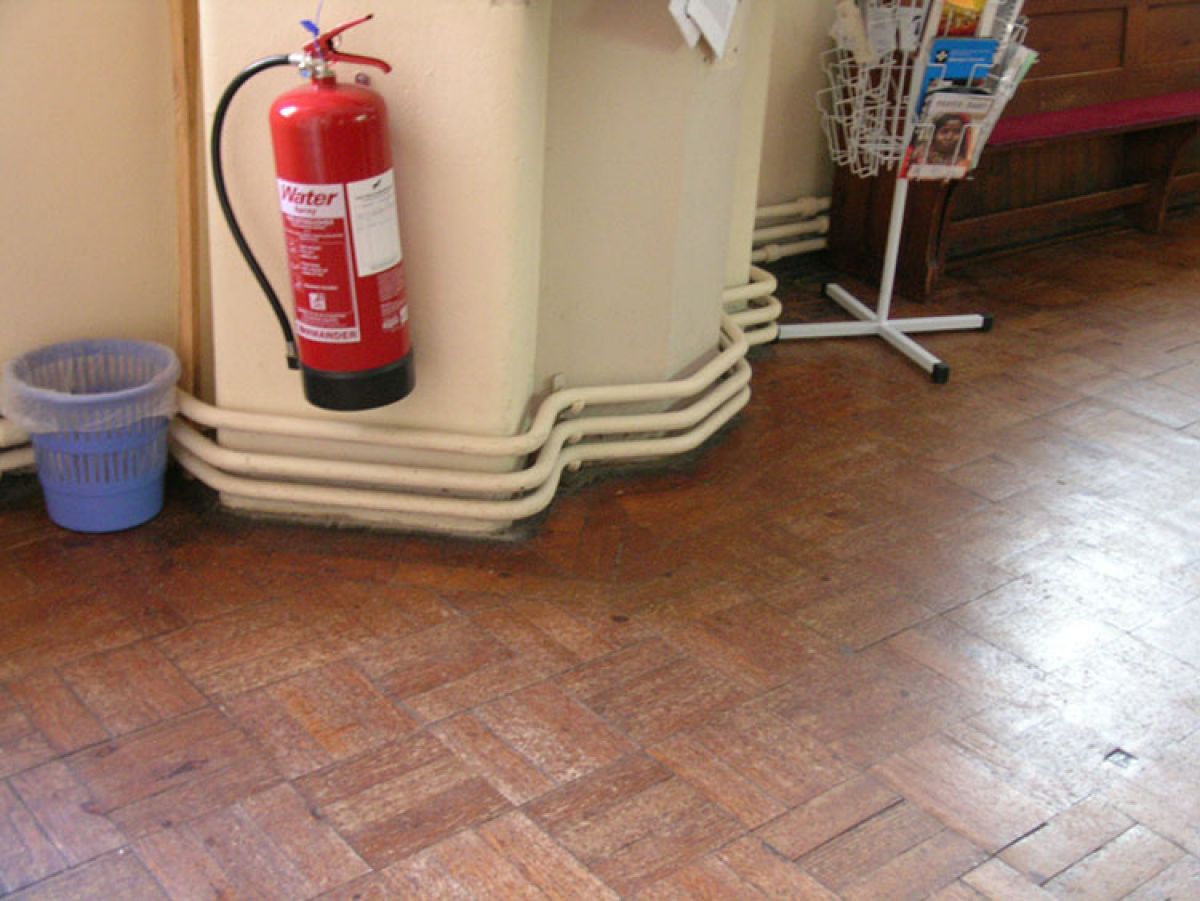 (Left) An example of particularly curvaceous pipework can be seen in the image of the system currently surviving in St Sidwells Methodist Church in Exeter.
Churches can pose problems for layouts especially the earlier large diameter installations. Bends, not always right angles and curves have to be accommodated as can be seen here (right) in Bovey Tracey Church.
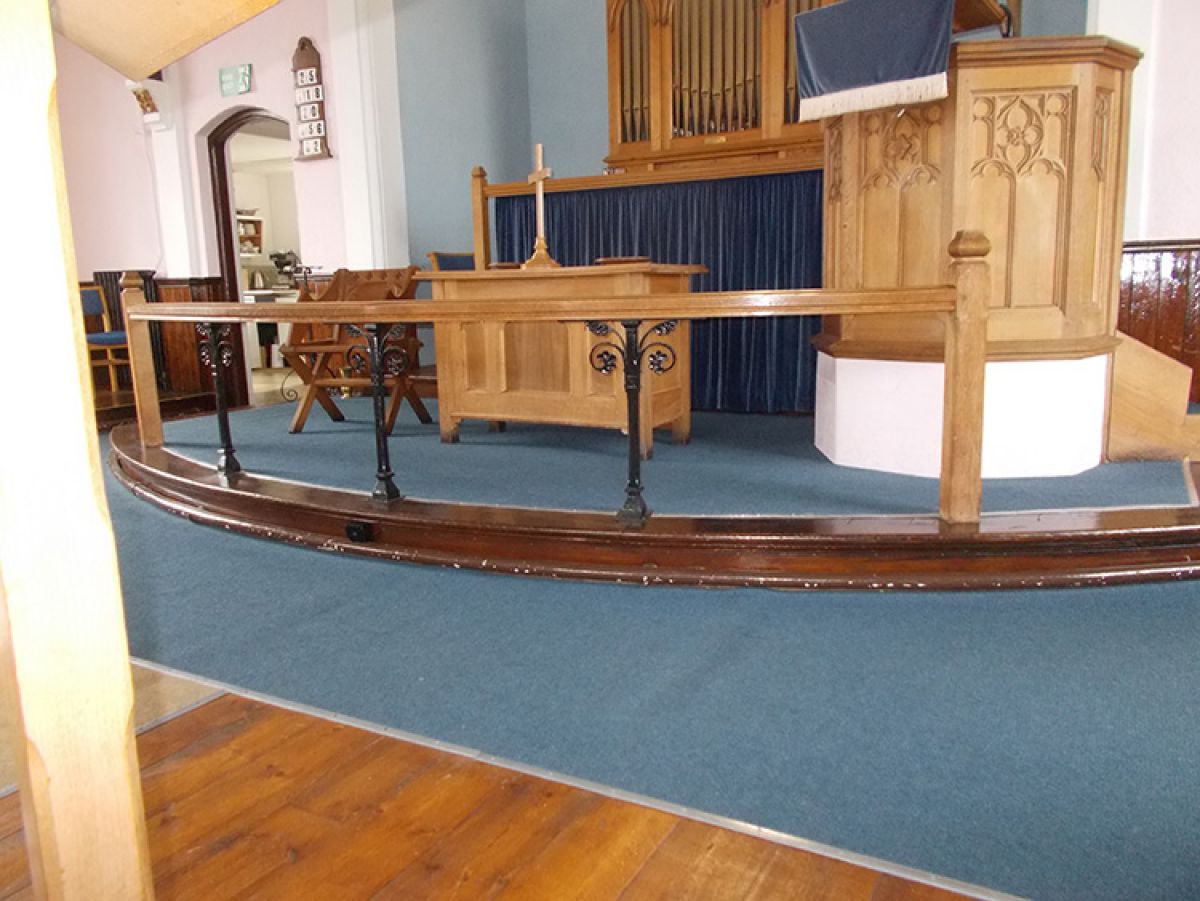
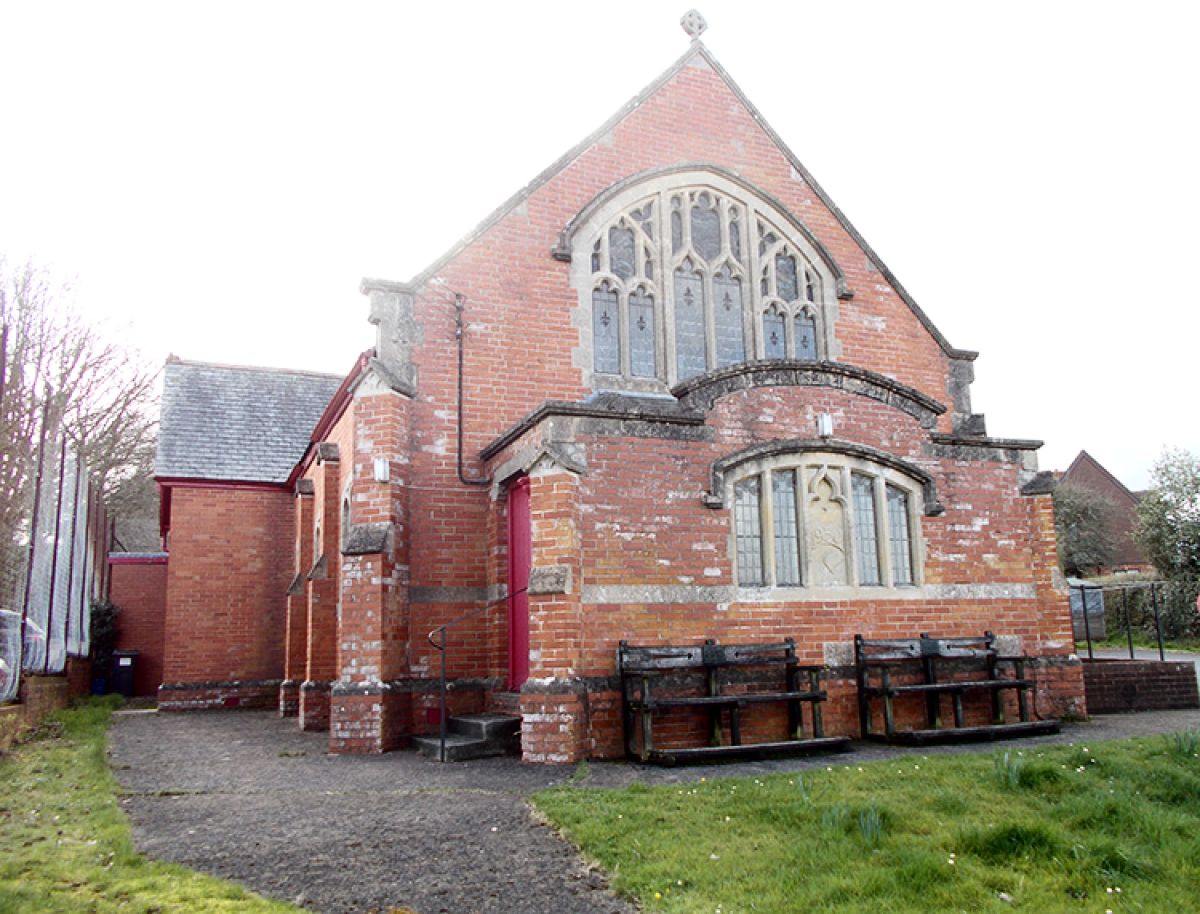 This image shows the curved pipe installed in the Methodist Church at Tedburn St Mary. It is tucked against the curved step marked by the Altar Rail.
This church was constructed by the well know Bradninch Builders W & A Nicks. The foundation stone was laid on the 30th July 1939. By this time G & K were following the trend for smaller diameter pipework, having scaled down from the 4” and 3” diameter used in the past. By the 1920s onwards mechanisation made the installation of heating pipework a tad easier to install as the laborious hand threading of pipes could now be assisted by the power of ‘Electricity!’ It is often the case that churches in which the company installed a heating system remain relatively unaltered to this day with the original pipework still in situ, even if the method of heating the water has changed with the installation of Gas or Oil Fired Boilers to replace those that were coke or coal fired.
St Georges Methodist Church, Truro
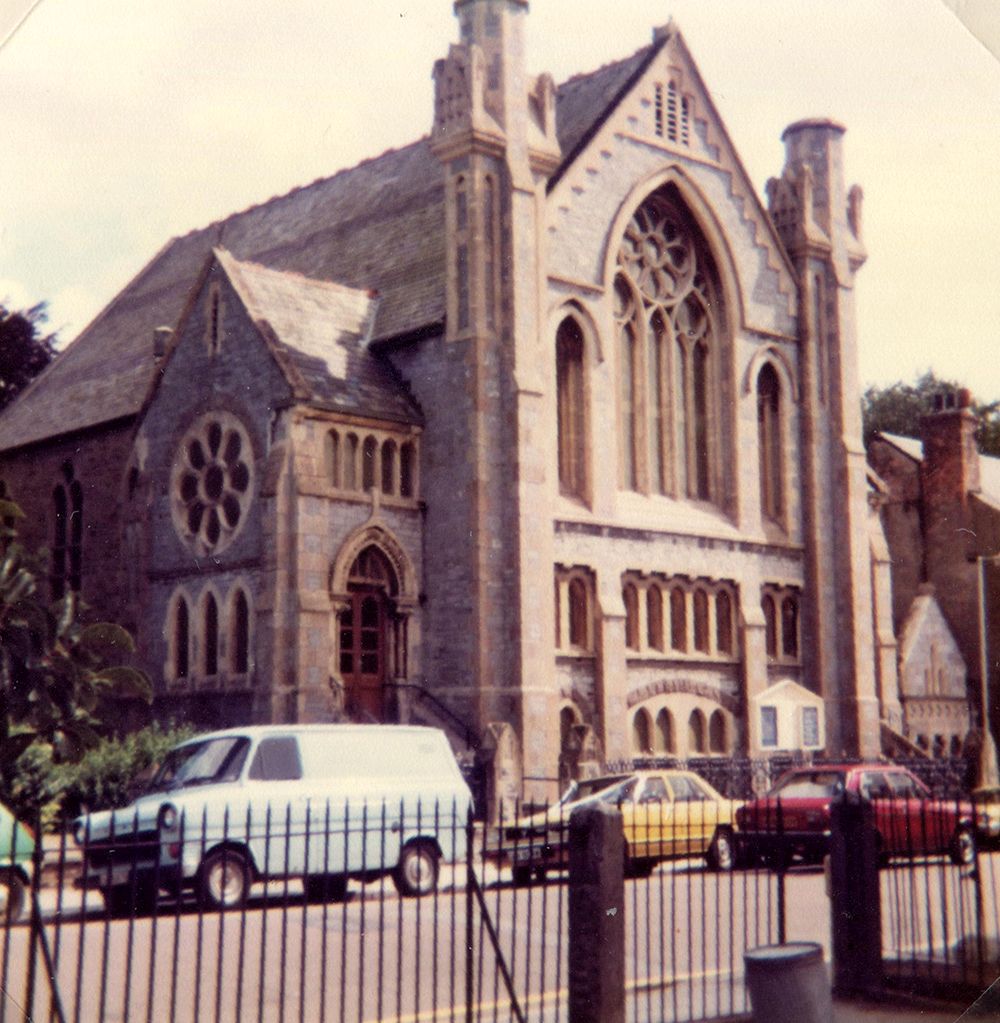
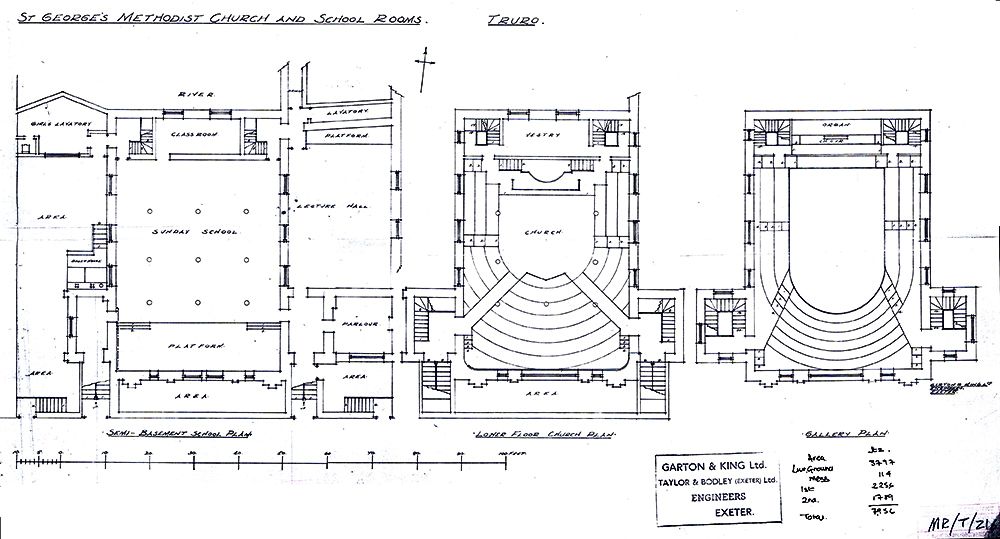 A plan of the heating for St Georges Methodist Church and School Rooms exists. Although undated and probably from the 1960s it does note the various areas of the property on the various floor levels. The image of the church is probably from the 1970s. Unfortunately in recent times the property has been completely altered as the church had fallen out of use. The property is listed. The inside has now been converted into flats and doubtless the builders stripped out any traces of the company’s work in the process.
St Georges Methodist Church Image - British Methodist Buildings online, courtesy of Oxford Brookes University and the estates of Keith Guyler and Bill Smith.
Oster Pipe Threading Machine
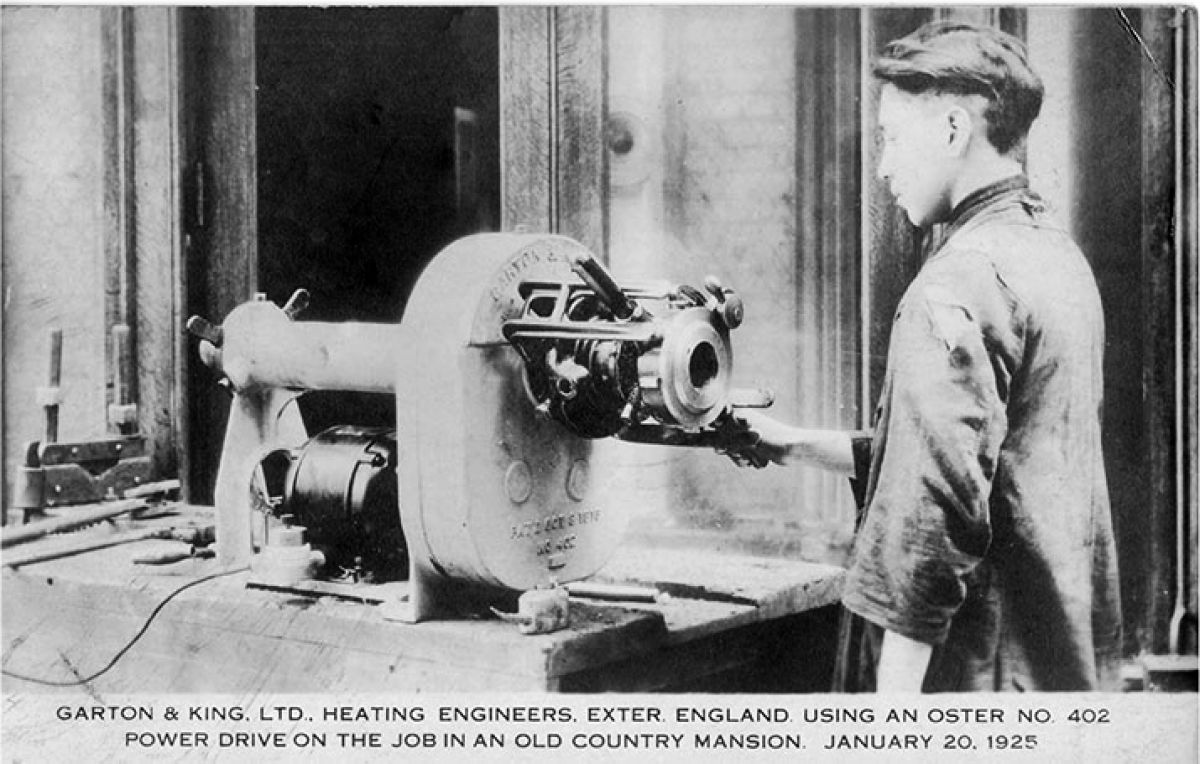
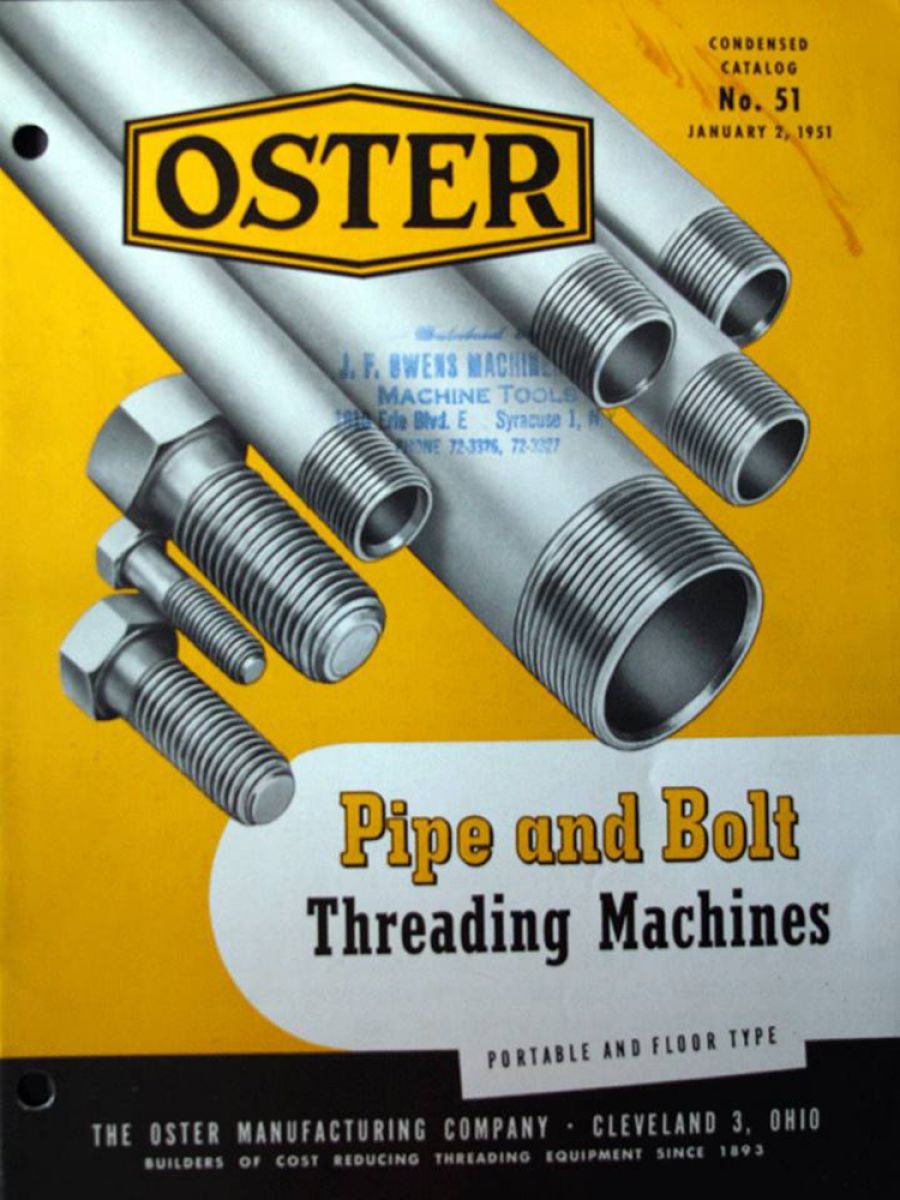 I have no doubt the company made use of the machines it had purchased from the Oster Manufacturing Company in the U.S.A. The Garton & King were doubtless a good customer as they had the name cast into the casing of the machine, it can be seen in the Black and White photo. The image shows an Oster 402 powered by an electric motor. The 402, referred to as ‘The Power Boy’ was the first power drive for pipe threading and was intended to be used in conjunction with Oster’s hand threading tools.
The Oster Manufacturing Company was founded in 1893 in Cleveland, Ohio, U.S.A. They aimed to create “the most complete line of Power Pipe and Bolt Threading Equipment” and their products were extensively exported.
https://www.ostermfg.com/about-us/museum
New Grammar School,Tavistock
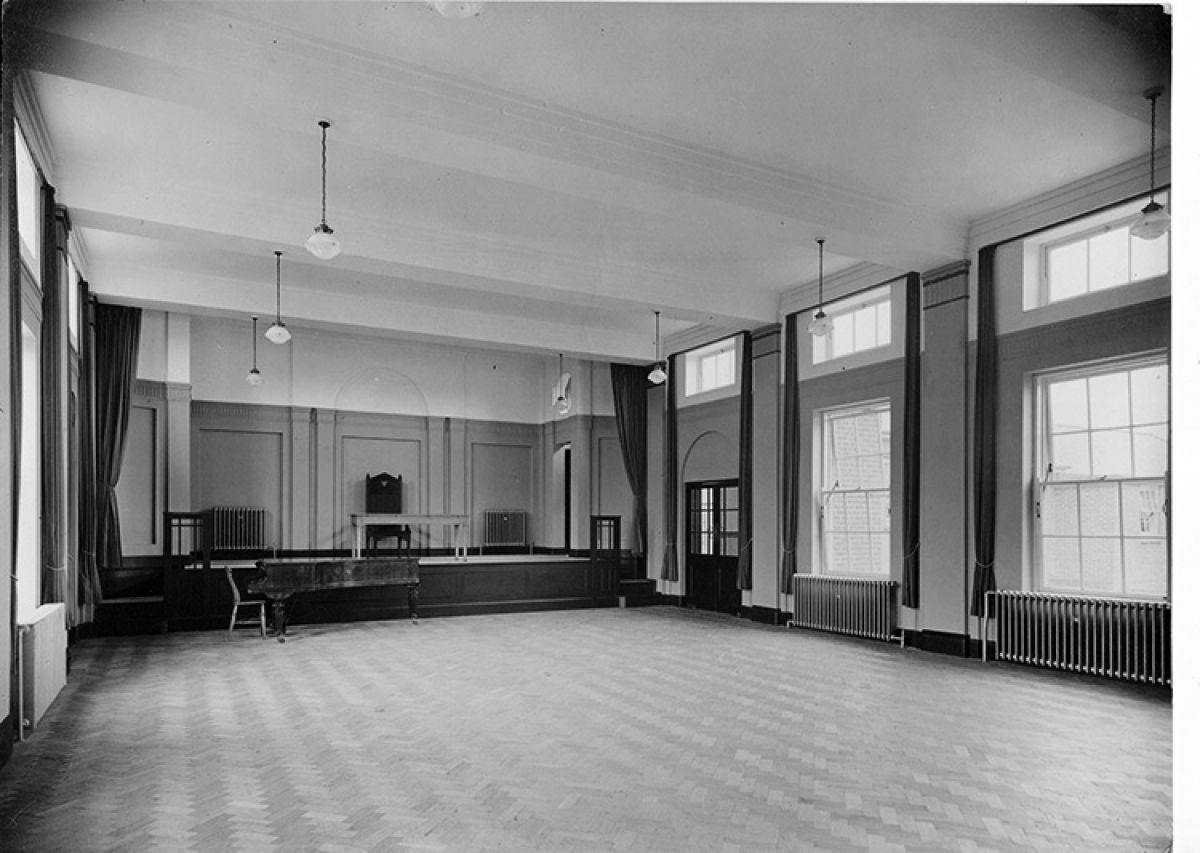 Perhaps an installation that is more familiar to our eyes is the one installed at the New Grammar School in Tavistock in 1931 – I think the building is now the Primary School. You have to look carefully, the radiators are located under the window.
Stoodleigh Court
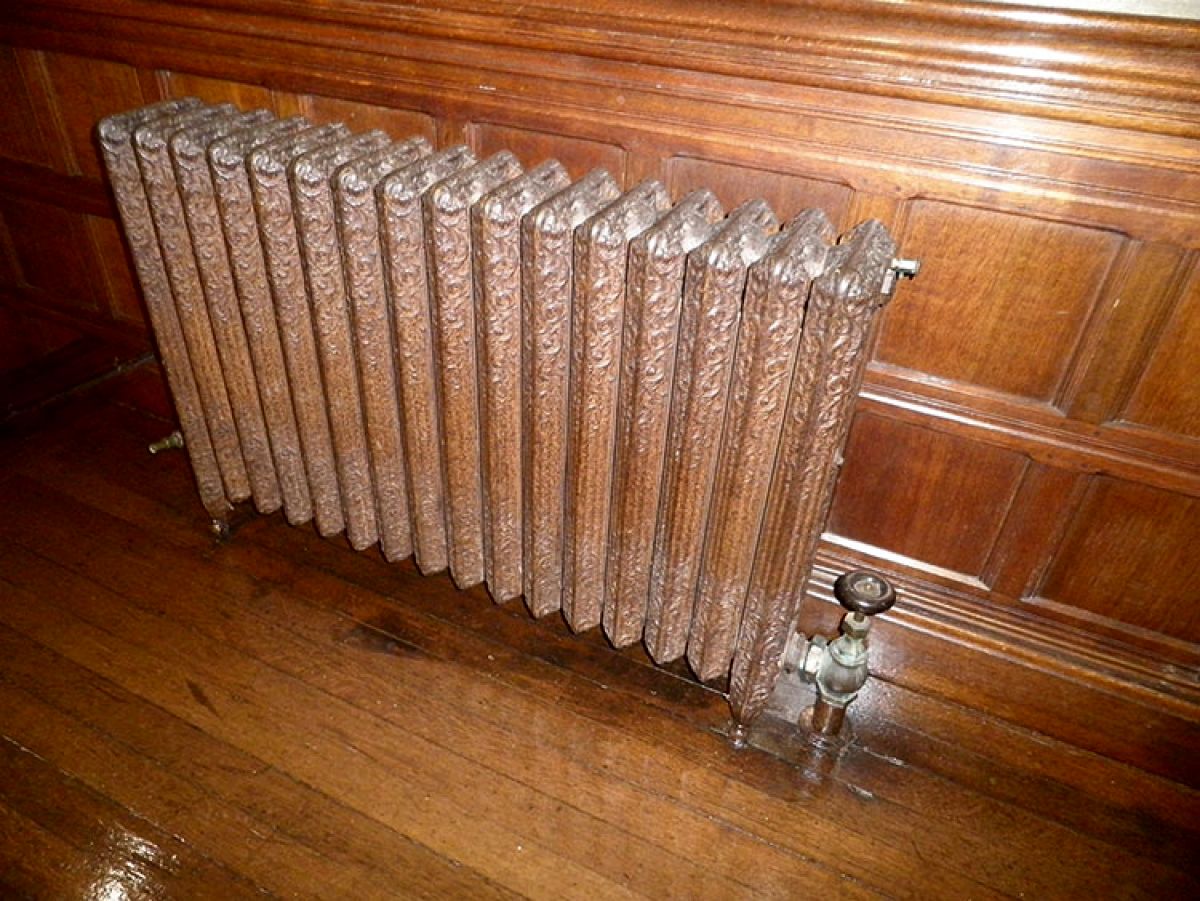 The images further up the page show Radiators of various designs, but perhaps one that should be included is from Stoodleigh Court near Tiverton. Much decoration cast into the ironwork can be seen.
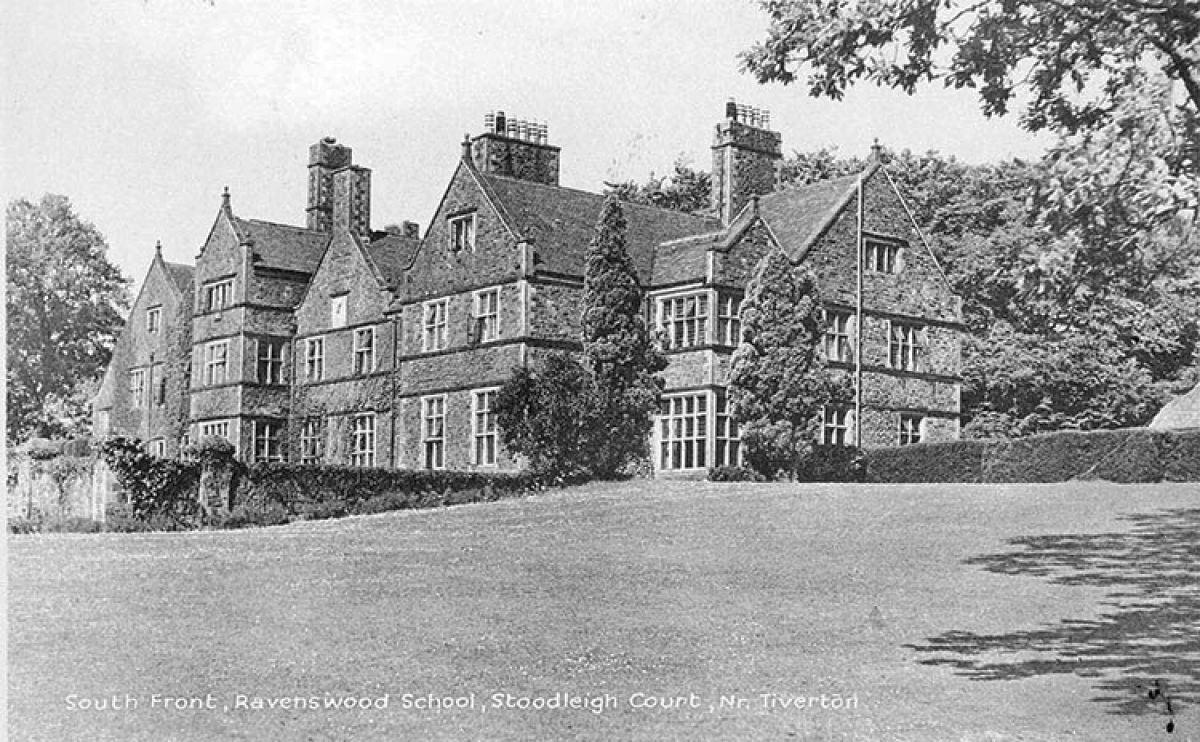
Stoodleigh Court Country House was built in 1881 and designed by architect Ernest George who won a Royal Academy Gold Award for this design in 1885. The house was built for Thomas Carew and his family on the original site of Stoodleigh Manor. A potted history of its early days can be found if you look on
www.stoodleighcourt.co.uk
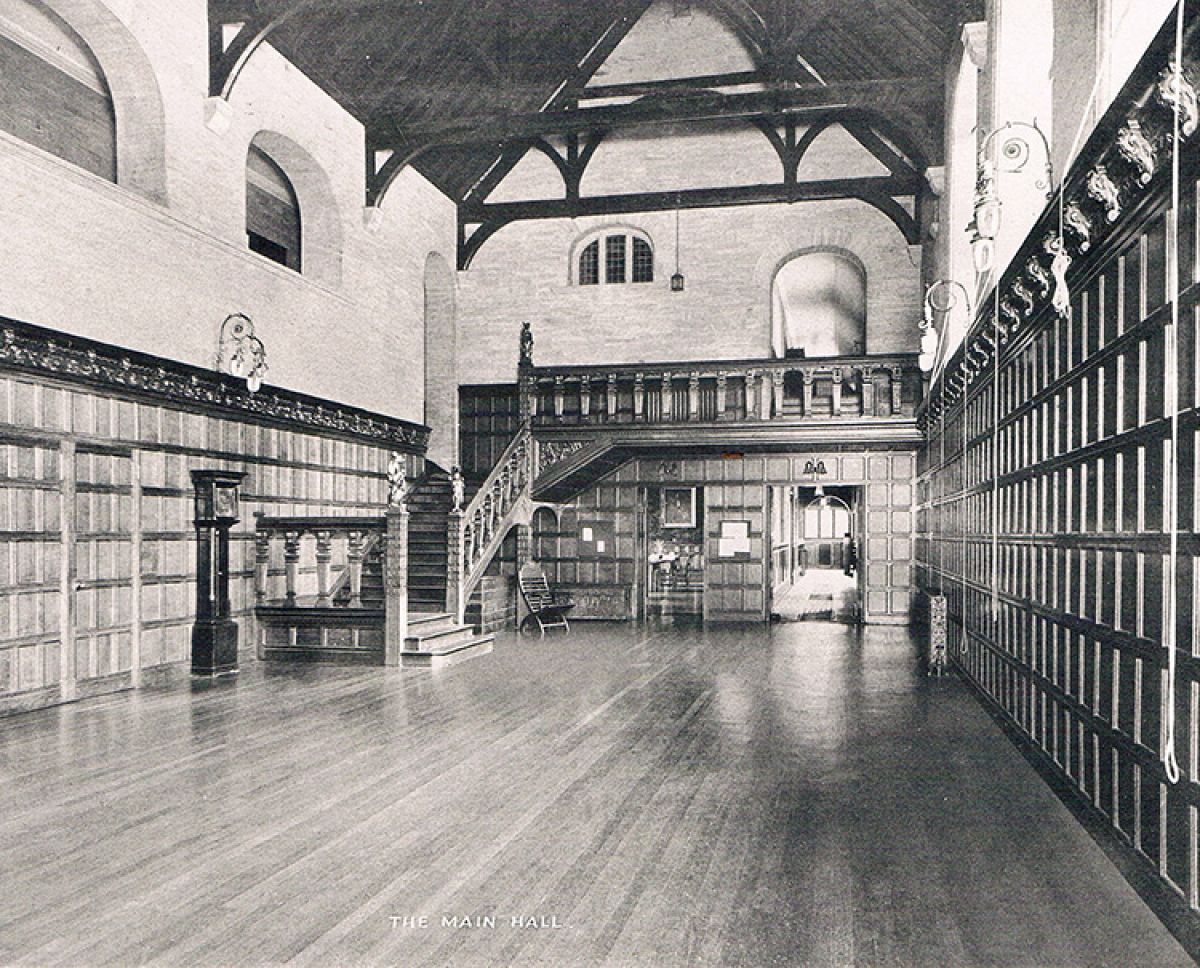
In 1928 the property was vacant, It was sold to Ravenswood School, a Preparatory Boarding School founded in 1921 that had outgrown its Paignton premises. In 1928 they moved in and the school remained there until a rather abrupt closure in 1992. G & K had installed the heating system for the original owners. It has to be said it was not very efficient! My brothers and I, who were taught there, can vouch for that. The original coal fired boilers which had been installed by Garton & King in the cellars of the house were dismantled to make way for oil fired heating probably back in the early 1970s. The current owners took over the house in 1994.
See www.ravenswoodschool.co.uk for more history & images.
Post-war Heating Systems
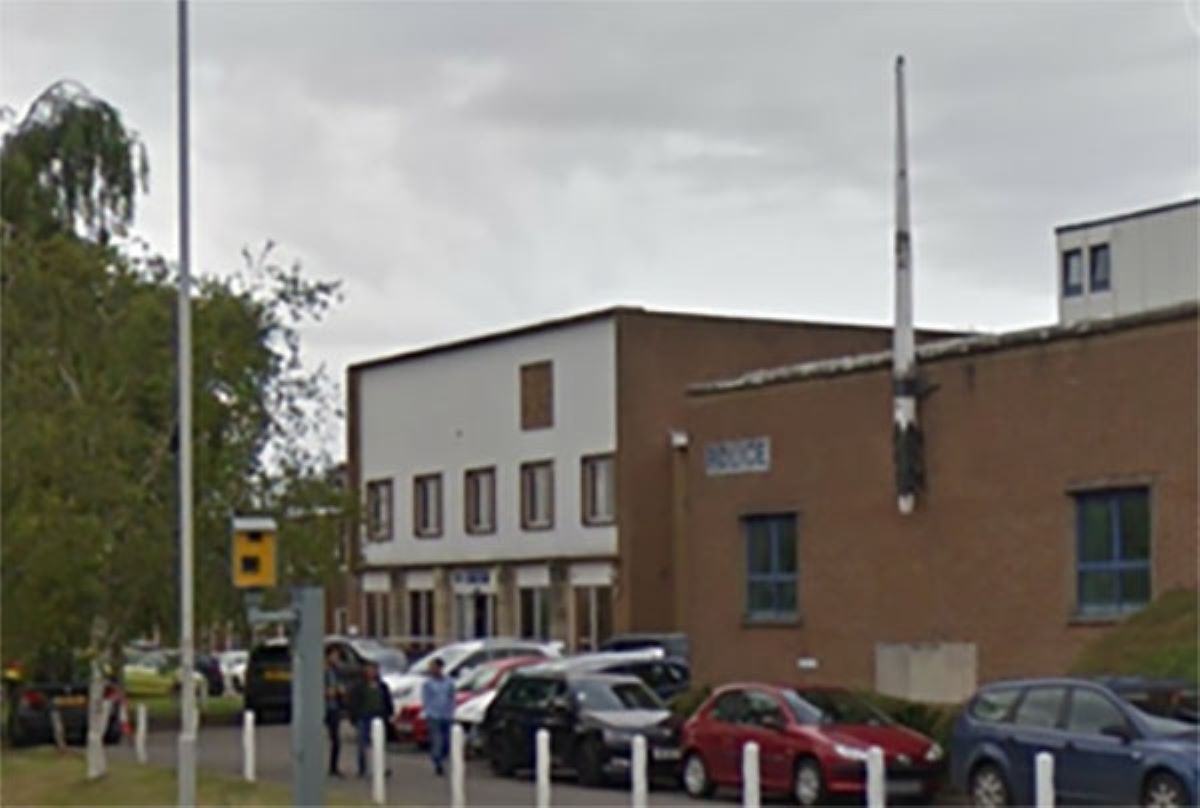 Written and recorded details of Post War commercial heating systems installed by the company are scarce. One can rely on details from former employees but often this consists purely of memories and little or no documentary evidence. It is known that the Heating System in the Heavitree Road Police Station, opposite St Lukes College, Exeter was designed and installed by the Company but even as this addition to this page is placed on the website (February 2022) the property is being demolished and redeveloped.
 One interesting discovery was the installation that had a write up in the Cornish Guardian on the 22nd May 1958.
(view whole page [PDF])
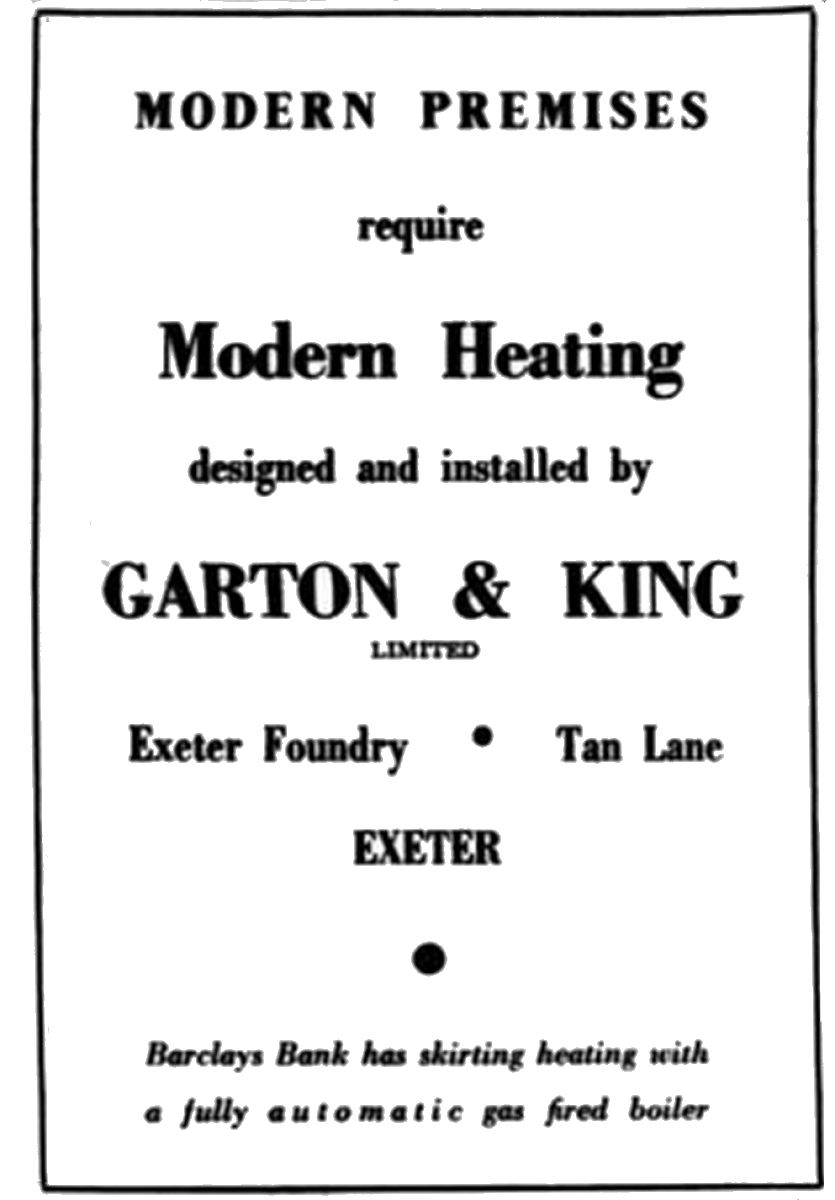
Barclays Bank at the appropriate address of 2 Bank Street, Newquay, Cornwall had last been modernised in 1915. It was originally founded in 1771 as The Miners Bank and has an interesting history. The site itself also prompted interest after modernisation of the premises started in July 1957 when, on excavating the area behind the premises, a mine adit was discovered, resulting in attention from the Old Cornwall Society. Garton & King’s involvement can be shown in the advert to the right.
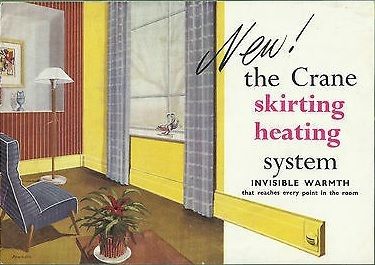
Crane, at that time, produced commercial ‘Skirting Heaters’ which G & K installed together with a fully automatic gas fired boiler. Crane Ltd was founded in Ipswich in 1919 - the US company was founded in 1855. Information on the company can be found on the CIBSE Heritage website, in particular their Heating products (PDF)
Some of you reading this may not be too familiar with 20th Century Banking, where every town, city and even large village boasted a branch of the major banks. In the 50s and 60s such names as National Provincial, Martins Bank, Barclays and Midland Bank were the main players. The Newquay branch of Barclays at 2 Bank Street, Newquay survived until closure on the 23rd October 2020 when Bank Street Newquay became ‘Bankless’.
Updated Feb 2022
Top of the page
See also:
Christ Church Chapel, Bridgwater — The Devon & Exeter Hospital
Hothouse Heating — Corbet's Hot-Water Apparatus
Exeter Cathedral — Cooking Equipment
Customers — Testimonials
Sitemap / Contents